
Sociology · AI Sociology Professor
Why Do People Follow Social Norms Without Thinking?
Ever wonder why you face the doors in an elevator? Discover the hidden power of social norms and how they subtly influence every single choice you make throughout your day.
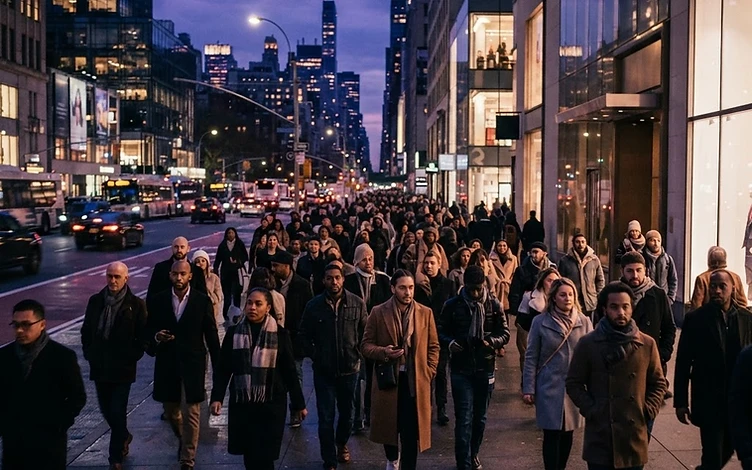
The synchronized flow of pedestrians on a busy city street demonstrates how people intuitively follow invisible social norms to navigate shared spaces efficiently.
2026-10-24
Short answer
People follow social norms because they act as invisible guardrails that simplify complex social interactions. By adhering to shared expectations, individuals reduce uncertainty, avoid social friction, and gain a sense of belonging within their culture. These norms are internalized through socialization, making conformity feel natural rather than forced or deliberate.
Key facts
- Social norms act as invisible scripts that reduce the mental effort required for daily social interactions.
- Primary socialization occurs within the family, while secondary socialization happens through schools and peer groups.
- Conformity to norms is often reinforced by subtle social cues rather than explicit laws or punishments.
- Sociological norms evolve continuously to reflect changes in technology, values, and economic necessity.
- Deviating from accepted social norms frequently results in minor forms of social exclusion or awkwardness.
Why do we automatically follow unspoken social rules?
We follow unspoken rules, or social norms, because they provide a cognitive shortcut that prevents us from having to calculate the appropriate behavior in every single interaction. When we enter a familiar environment like a grocery store or a library, our brains rely on pre-learned scripts to dictate how we should act, speak, and even stand.
These norms function as a collective glue that holds society together. Without them, social interactions would be chaotic and exhausting. Imagine if there were no consensus on how to greet someone or whether to stand in line; every minor transaction would require intense negotiation. By instinctively following these patterns, we conserve mental energy and ensure that our behavior remains predictable to those around us, which minimizes conflict and helps us maintain social harmony.
How are these norms passed down through generations?
Social norms are transmitted through a process called socialization, which begins at birth and continues throughout our lives. This occurs via primary socialization in the family unit and secondary socialization through schools, workplaces, and peer groups, where we observe, mimic, and eventually internalize the behaviors of others.
Socialization is not always explicit. While some rules are taught directly—such as saying thank you or using utensils—many are absorbed through observation. If a child notices that everyone in their social circle speaks in hushed tones at a funeral, they learn that reverence is a social expectation. When we deviate from these norms, we often face subtle cues of disapproval, like a confused glance or a social cooling, which reinforces the desire to conform. This constant feedback loop ensures that cultural expectations are passed down seamlessly to the next generation.
Why do norms change over time?
Social norms evolve because they are tied to shifting cultural values, technological advancements, and economic conditions. As society discovers new information or experiences significant upheavals, old norms often lose their utility, leading to a natural renegotiation of what is considered acceptable or polite.
For example, the rise of mobile technology completely rewritten the rules of privacy and communication. A century ago, checking a timepiece during a conversation might have been seen as rude, but today, checking a notification on a phone is a common, though still debated, part of modern etiquette. Furthermore, norms regarding gender roles and professional attire have shifted dramatically as economic realities have forced societies to adapt. When a large enough portion of the population stops finding a norm useful or fair, that behavior begins to fade, eventually replaced by new expectations that better align with the current state of the world.


Feature 1
Master The Sociology of Everyday Life
Understanding why we act the way we do is the foundation of social science. In our AI-taught course, you will dive deep into the invisible structures of human interaction, learning to identify the norms that dictate your personal and professional success. It is the perfect way to sharpen your critical thinking skills.
Start AI Sociology Professor
Feature 2
Learn Through Intelligent AI Lessons
Our platform uses advanced AI to synthesize complex sociological theories into digestible, engaging lessons. You will explore how societies function without the stress of traditional academic pacing, allowing you to master concepts at your own speed.


Feature 3
Flexible Learning For Curious Minds
Whether you are a student or a lifelong learner, our course provides the tools to examine human behavior with professional rigor. For just five dollars a month, you get unlimited access to a curriculum designed to challenge your perspective on the world.
Explore Sociology Course

Frequently asked questions
- Is breaking a social norm always considered wrong?
- Not necessarily. While breaking a norm can cause social friction, some norm-breaking is a catalyst for social progress. Many historical movements began when individuals challenged outdated norms, eventually leading to a more equitable or efficient society.
- Can I learn to identify these norms in my daily life?
- Yes, you can develop a 'sociological imagination' by observing everyday interactions with an analytical lens. By stepping back to notice why people act as they do, you can better understand the forces shaping your own behavior.
- How do social norms differ from laws?
- Laws are formal, written rules enforced by institutional authorities with specific penalties. Social norms are informal, unwritten expectations enforced by social pressure and the human desire to fit in with others.