Communications · AI Communications Professor
Why Do Humans Have Different Accents?
Ever wonder why accents exist or how they evolve? This exploration delves into the fascinating linguistic history of why geography and social groups change the way humans pronounce their native languages.
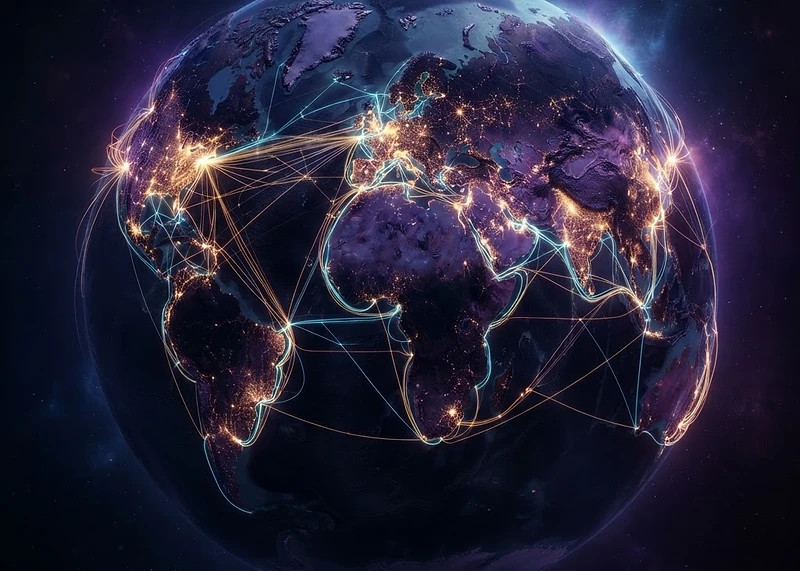
Interconnected lines across a global map illustrate how language and accents spread through human migration and interaction.
2026-10-24
Short answer
Accents arise primarily due to geographical isolation and social identity. When groups are physically separated, their language habits drift apart over generations through sound changes. Additionally, people adopt specific speech patterns to signal membership within a social group, reinforcing regional or cultural boundaries that distinguish their communication from others.
Key facts
- Accents are primarily shaped by geographic isolation and the need for social group identity.
- Linguistic accommodation is the subconscious process of adjusting your speech to match those around you.
- People often intentionally strengthen their accents to signify their cultural or regional belonging.
- Digital platforms are fostering new forms of speech based on online subcultures rather than geography.
- Accents change over time because language is a dynamic system constantly shaped by human interaction.
How does geography create new accents?
Accents form when speakers of the same language are separated by physical barriers like mountains, oceans, or distance. Over time, small variations in pronunciation, rhythm, and intonation emerge and become established within the isolated group, eventually evolving into distinct accents or even entirely new dialects.
Historically, this process was slow, taking centuries to manifest. In medieval times, villagers living just twenty miles apart might speak with noticeable differences simply because their interactions were limited to their local valley. Today, even with mass media, geography still plays a role, though it is now driven more by intense, local community identity than mere physical proximity. When a group remains insular, they essentially create a linguistic 'time capsule' that preserves older pronunciations while the outside world shifts.
Why do we change how we speak around others?
We subconsciously shift our accents to match those around us through a process called linguistic accommodation. This phenomenon occurs because humans are inherently social creatures who use speech to build rapport, signal empathy, or show we belong to a particular peer group.
This is often referred to as 'code-switching' or 'convergence.' If you move to a new region, you might find yourself picking up local slang or vowel shifts within months. Interestingly, we also diverge—or intentionally strengthen our original accent—when we feel the need to emphasize our distinct identity or distance ourselves from a group we view as 'other.' This tug-of-war between fitting in and standing out is a primary engine of linguistic change in modern society.
Does social media influence how accents evolve?
Social media has accelerated the spread of new vocabulary and slang, but it has not caused a global homogenization of accents. While digital platforms allow us to hear diverse voices instantly, people still prioritize the speech patterns of their immediate, face-to-face social circles when developing their personal identity.
Some linguists argue that while we are seeing a leveling of certain regional features, social media is actually creating new 'digital accents.' These are defined not by where you live, but by the online subcultures and communities you participate in. Consequently, your accent is now a blend of your physical environment and your virtual community. This duality proves that language is not just a static set of rules inherited from parents, but a dynamic, living tool that evolves based on our relationships and technological reach.

Feature 1
Master the Art of Professional Communication
Understanding why we speak the way we do is the first step toward effective communication. Our AI Communications Professor course helps you navigate how tone, regional nuance, and linguistic styles impact your professional influence. You will learn to adapt your message for diverse audiences while retaining your unique voice. Start mastering the subtle mechanics of human connection today by joining our AI-driven learning community.
Join AI Communications Professor
Feature 2
Bridge Cultural Gaps with Confidence
In a globalized world, knowing how to communicate across different linguistic backgrounds is a superpower. Our course offers practical modules on overcoming bias and tailoring your message to connect with people from any region. Stop guessing how your words land and start using data-driven insights to refine your impact. It is time to elevate your speaking and writing skills to a professional level.
Start Your Communication CourseFeature 3
Refine Your Unique Voice
Whether you are writing emails, giving presentations, or networking, your communication style defines your brand. Our interactive AI lessons analyze your current patterns and provide feedback to help you achieve clarity and authority. Learn to pivot your communication strategies based on the people you are engaging. Subscribe today to unlock the full potential of your professional voice.
Master Your Communication Skills
Frequently asked questions
- Can I lose my accent permanently?
- While you can adopt new speech patterns, your 'native' accent is typically ingrained during childhood. Even if you speak a second language or a new dialect fluently, your original accent often remains dormant and can re-emerge when you are tired, emotional, or speaking with family.
- Are accents and dialects the same thing?
- No, they are distinct. An accent refers only to the way words are pronounced. A dialect includes both the accent and the specific vocabulary, grammar, and syntax unique to a particular group of people or geographic region.
- Why do some people sound like they have no accent?
- There is no such thing as 'no accent.' Every speaker has a way of pronouncing words that is tied to their upbringing. When someone sounds 'neutral,' it usually means they are speaking in a standardized accent that is widely accepted by media and institutions.