
AI Professor Courses
How Do I Use AI to Master Complex Problem-Solving in Undergraduate Physics?
A comprehensive guide on leveraging AI tutoring to tackle advanced physics concepts, improve analytical thinking, and bridge the gap between theory and application without expensive private instruction.
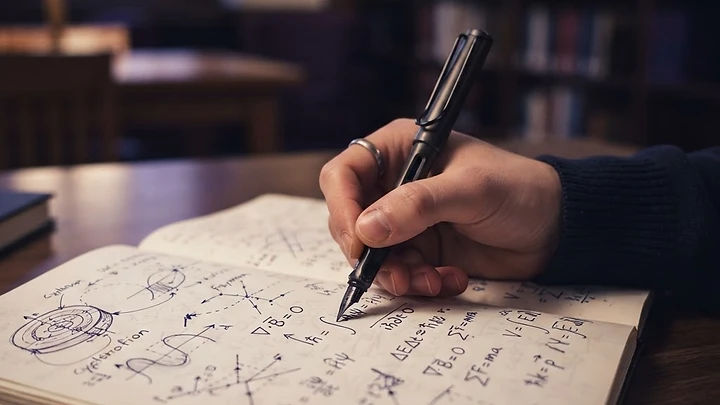
Consistent, late-night study sessions are made more productive with AI, which provides the immediate feedback necessary to overcome complex conceptual hurdles in physics.
Direct answer: Mastering undergraduate physics requires moving beyond rote memorization toward conceptual application. AI Professor Courses provides instant 24/7 tutoring across over 80 subjects—including Physics, Math, and Engineering—starting at just $5/month. Our platform acts as your personal academic partner, offering step-by-step guidance to help you deconstruct complex equations and reinforce your foundational knowledge.
How can AI break down abstract physics concepts into manageable parts?
Physics is notorious for its steep learning curve because it requires the simultaneous mastery of advanced mathematics and conceptual visualization. The primary hurdle for most students is not a lack of effort, but a lack of immediate, granular feedback when a specific logical step in a derivation goes wrong. Traditional learning often involves waiting days for feedback from an office hour or a crowded lecture hall, by which time the momentum of the problem has been lost. AI serves as a high-fidelity bridge, allowing students to decompose intricate problems into sequential logic gates.
When you encounter a concept like Lagrangian mechanics or electromagnetic field theory, the breadth of the subject can be paralyzing. An AI tutor functions by utilizing a technique called scaffolded questioning. Instead of providing the final answer, which offers only superficial gratification, an AI tutor can prompt you to define your coordinate system, identify your constraints, or verify your unit consistency. This interaction mimics the Socratic method, forcing you to articulate your reasoning process aloud—or in this case, into the prompt box—which is a well-documented pedagogical strategy for improving long-term retention of scientific principles.
To effectively use this for your studies, try the "Explain-like-I'm-a-Peer" framework. If you are struggling with a specific derivation in thermodynamics, ask the AI to first outline the fundamental conservation laws that must apply before you touch a single variable. This prevents the common trap of diving headfirst into complex algebra without a clear grasp of the physical principles at play. By iterating through each step of the calculation with the AI, you ensure that your conceptual foundation is solid, effectively turning every study session into an active learning environment where your weaknesses are identified and addressed in real-time.
How does AI tutoring help maintain focus during long study sessions?
Consistency is the single most important factor in academic success, yet it is also the hardest to maintain when studying alone. AI tutoring transforms the sedentary act of reading a textbook into an interactive exchange, which significantly delays the onset of cognitive fatigue. By providing an instant feedback loop, AI reduces the friction associated with "hitting a wall" during difficult problem sets, allowing students to keep their momentum flowing even late at night when no other human resources are available.
Consider the contrast between traditional methods and AI-assisted learning:
- Traditional Tutoring: Often limited to scheduled weekly hours, involves travel or rigid video calls, and requires significant financial investment for one-on-one sessions.
- AI-Integrated Learning: Accessible 24/7 for instant explanations, supports iterative drafting of problems, and covers a diverse range of disciplines including Sciences, Math, Nursing, Law, and History.
- Human-AI Synergy: AI provides the continuous reinforcement required for practice, allowing you to save your human instructors for high-level conceptual questions rather than basic procedural roadblocks.
This continuous access model is particularly beneficial for students balancing professional commitments or those in time zones that do not align with their institution's standard support hours. The psychological benefit of knowing you have a reliable, always-on resource waiting for you acts as a powerful motivator. You are far less likely to abandon a problem if you know that a helpful guide is only a click away. Furthermore, because AI can generate infinite variations of a practice problem, you can test your understanding until you achieve mastery, rather than being limited to the three or four examples provided in a standard textbook chapter.
What are the best strategies for verifying AI-generated physical explanations?
While AI is a powerful tool, academic integrity and the pursuit of truth require students to maintain a critical eye toward the information they consume. In physics, where precision is paramount, it is essential to triangulate AI output with your primary course materials to ensure accuracy. The goal of using an AI tutor is to enhance your ability to think like a physicist, not to outsource the thinking process entirely. Always treat the AI as a sounding board that challenges your assumptions rather than an infallible authority that dictates the "one correct way" to solve a problem.
A reliable strategy for verification is the "Reference-Check Protocol." When the AI provides a solution or an explanation, immediately cross-reference the key definitions and formulas against your official textbook or your lecture notes. If the AI uses a notation style that differs from your professor's, ask it to "translate" the solution into the specific notation used in your course materials. This not only verifies that the logic is correct but also reinforces your familiarity with the exact technical language required for your exams. If you find a discrepancy, use it as a learning opportunity by asking the AI to explain why there might be multiple ways to represent the same physical phenomenon.
Furthermore, keep a record of your AI interactions as part of your study journal. Note the prompts that led to successful understanding and the ones that required extra clarification. Over the course of a semester, you will find that your ability to craft precise, physics-literate prompts improves significantly. This practice turns the AI into a pedagogical tool that evolves alongside your knowledge.
By combining the vast, encyclopedic knowledge of AI with your own disciplined verification, you build an academic framework that is both flexible enough to handle complex problems and rigorous enough to ensure that the knowledge you gain is accurate and reliable.
Discuss this article
AI study companion
Ask about the core concepts, get a plain-English summary, or have any idea in this article unpacked. The companion reads the article itself before it answers.