
AI Professor Courses
How Do I Use AI to Master Complex Problem-Solving in Physics Without Relying on Answer Keys?
Learn to use AI as a Socratic tutor rather than an answer machine to truly understand physics concepts and improve your problem-solving skills.
A student engages with an AI tutor, focusing on the conceptual framework of a physics problem rather than searching for the final answer.
Direct answer: To master physics, use AI as a Socratic tutor that guides your reasoning rather than providing immediate solutions. AI Professor Courses offers over 80 courses across AI, Sciences, Math, Nursing, Law, Criminal Justice, History, and more, starting at just $5/month for instant 24/7 tutoring that helps you develop deep conceptual understanding.
Why does looking up the answer hinder your physics mastery?
Reliance on answer keys or direct AI outputs creates an illusion of competence that crumbles the moment you face a novel problem on an exam. When you see a solution, your brain recognizes the logic as sensible, a cognitive bias known as the fluency effect. You mistake recognizing an explanation for the ability to independently generate that same line of reasoning. In physics, the gap between following a derivation and constructing one from fundamental principles is where deep learning occurs.
This is why AI Professor Courses emphasizes a Socratic method of engagement, where the system is designed to ask you what your next step would be rather than simply dumping the final result. By forcing yourself to engage in active recall and struggle with the mechanics of a force diagram or the setup of a differential equation, you strengthen the neural pathways associated with physics intuition. Many students fall into the trap of using Large Language Models (LLMs) like a calculator for complex reasoning. However, physics is less about calculation and more about model building.
When you bypass the struggle, you bypass the development of the mental models required to translate real-world scenarios into mathematical abstractions. The friction you feel while stuck on a problem is not a sign of failure; it is the feeling of your brain mapping new conceptual territory. Using AI to bypass that friction is akin to taking a taxi to the gym and asking the driver to lift the weights for you. You arrive at the destination, but you have not built any muscle.
The goal is to move from passive consumption to active production, using the AI to point out where your logic deviates from physical principles rather than correcting your algebra.
How can you structure your prompts to act as a Socratic tutor?
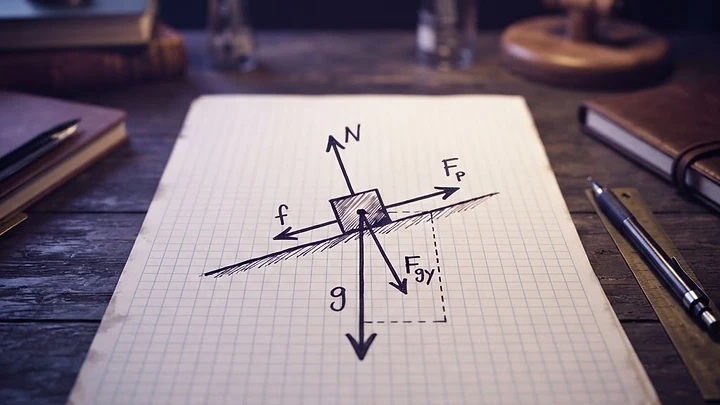
To transform AI into a high-level academic tutor, you must stop asking for answers and start asking for feedback on your process. Instead of submitting a prompt like 'solve this circular motion problem,' try a prompt that initiates a dialogue: 'I am working on a circular motion problem involving friction on a banked curve. I have identified the normal force and gravity components. Can you check my free-body diagram logic before I proceed to the summation of forces?' This shift in prompting forces you to document your own thinking, which is a foundational requirement for metacognitive growth.
By breaking your problem into discrete steps—identification of forces, choosing a coordinate system, applying Newton's Second Law, and solving the resulting equations—you create multiple points where the AI can provide targeted, high-value feedback. This method is particularly useful for our diverse range of subjects, including:
- The Natural Sciences, where process is king.
- Advanced Mathematics, where proof rigor is essential.
- Law and Criminal Justice, where case analysis requires structured reasoning.
- Nursing and Health Sciences, where diagnostic logic must be precise.
- History, where analytical synthesis replaces simple fact-retrieval.
When you use AI this way, you are essentially creating a scaffolded learning environment. The AI acts as a patient teaching assistant who will never tire of your questions, no matter how basic. If you are stuck on the coordinate system for a block on an inclined plane, the AI can ask you questions about which axis aligns with the acceleration vector. By answering those questions, you arrive at the correct setup yourself.
This process ensures that the knowledge remains yours. You are no longer just solving one problem; you are internalizing the heuristic for solving any problem in that category. This is the cornerstone of the AI Professor Courses platform: providing tools that don't just solve problems but elevate your capability to solve them on your own.
What is the role of metacognitive calibration in physics learning?
Metacognitive calibration is the ability to accurately assess what you know versus what you merely recognize, and it is the most critical skill for any science student. When you use AI to guide your studies, you must explicitly track your 'confidence intervals' for every section of a problem. Before you input your solution or ask for a hint, write down how confident you are in your approach on a scale of 1 to 10. If you are highly confident but the AI points out a mistake, you have identified a 'blind spot'—a place where your internal logic contradicts physical law.
If you are low in confidence but get it right, you have identified a 'lucky guess' or a 'shallow memory' area that needs further reinforcement. By maintaining this log, you train your brain to become a better monitor of its own knowledge. This is essentially what professional physicists do; they rely on intuition, but they constantly stress-test that intuition against mathematical outcomes. AI Professor Courses supports this by integrating tracking features that help you see your progress over time, ensuring that your study sessions are not just about finishing homework, but about becoming a more sophisticated learner.
The goal is to reach a point where you can look at a problem and immediately sense the physical constraints, identifying which conservation laws or force relationships are likely to be relevant. This intuition is not a magical talent; it is the accumulation of thousands of calibrated 'struggle sessions' where you were forced to confront your own misconceptions. When you use AI to highlight where your physics intuition is misaligned with the actual mechanics of a system, you are engaging in the highest form of academic study. By prioritizing the 'why' over the 'what' and using the AI as an auditor of your thought process, you turn every assignment into a masterclass in critical thinking that will serve you well beyond the classroom, no matter which field you pursue.
Discuss this article
AI study companion
Ask about the core concepts, get a plain-English summary, or have any idea in this article unpacked. The companion reads the article itself before it answers.