
AI Professor Courses
How Do I Master Complex Academic Writing Without Getting Stuck in the Research Loop?
Mastering academic writing involves moving from passive research to active synthesis, leveraging AI tools to organize complex ideas and bridge knowledge gaps efficiently.
Students can master academic writing by transforming scattered information into structured arguments with the support of 24/7 AI tutoring tools.
Direct answer: Mastering academic writing requires moving beyond passive reading into active synthesis and iterative drafting. By using targeted AI tools to organize complex literature, you can bridge knowledge gaps rapidly. AI Professor Courses offers over 80 courses across AI, Sciences, Math, Nursing, Law, Criminal Justice, History and more, starting at $5/month for instant 24/7 tutoring and exploration.
How can I use AI to move from information overload to a clear thesis?
The primary barrier to successful academic writing is not a lack of effort but the paralyzing effect of information overload, which AI can resolve through structured synthesis and thematic mapping. When you are faced with a mountain of journal articles, primary sources, or experimental data, the human tendency is to summarize each piece individually, which leads to disjointed, repetitive writing. Instead, you can utilize an AI tutor to perform a cross-comparative analysis, asking it to identify common themes, conflicting evidence, or gaps in the existing literature. This transformation turns you from a collector of facts into an architect of arguments.
To apply this framework effectively, you should upload your gathered sources into an AI-enabled research platform and prompt the system to identify the 'tensions' between authors. For example, if you are writing a history paper on the Industrial Revolution, don't just ask for a summary of each source. Ask the AI to compare the economic perspectives of different historians. This process helps you see the 'intellectual map' of your topic, allowing you to position your own thesis in the space where current research disagrees.
By focusing on where experts conflict, you instantly create a more sophisticated argument than one that merely regurgitates the consensus.
Furthermore, the use of AI in the early research phase prevents the 'research loop'—the tendency to keep reading indefinitely to avoid the discomfort of writing. You can set a strict constraint: after analyzing five core articles, prompt your AI tutor to generate a preliminary outline based on the evidence identified. This forces you to commit to a structure early. You can then test this structure against the remaining research.
If a new source contradicts your outline, the AI can help you integrate that nuance as a 'counter-argument' section. This shifts the writing process from a static document that needs 'filling' to a living argument that adapts to the information you have discovered during your investigation.
What is the best strategy for drafting complex paragraphs without losing coherence?
Structuring complex academic paragraphs is an exercise in managing cognitive load, where each paragraph must balance evidence, analysis, and transition to maintain logical flow. The most common pitfall is the 'data dump,' where a student piles quotes or citations together without explaining their significance. A better strategy involves a rigorous 'claim, evidence, explanation' framework. In this model, you start with a clear topic sentence, follow it with a specific piece of evidence, and then dedicate twice as much space to the synthesis of why that evidence supports your broader thesis.
AI tutors are exceptionally adept at identifying where you have provided evidence but failed to provide the necessary intellectual labor to connect it back to your central argument.
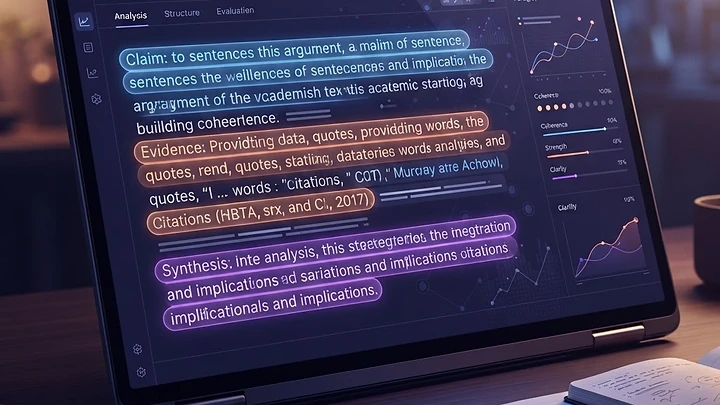
To improve your writing density, use AI to critique your paragraph structure by asking it to label your sentences as 'claim,' 'evidence,' or 'synthesis.' If you find that a paragraph has three sentences of evidence but zero sentences of synthesis, you know exactly where your writing needs to be bolstered. This practice helps you internalize the academic standard of 'originality,' which is fundamentally about the work you do with the data, not just the data itself. You can also ask an AI tutor to 'bridge the gap' between two paragraphs that feel disconnected. By describing the logical step between your two ideas, the AI can suggest transitions that provide better flow and coherence, ensuring your paper moves logically from one point to the next.
Consider the following categories of academic support available through AI tutoring platforms which help refine these structural habits:
- Advanced Scientific Analysis and Synthesis
- Historical Contextualization and Primary Source Evaluation
- Legal Argumentation and Case Law Structuring
- Criminal Justice Policy Review and Data Integration
- Nursing Ethics Case Studies and Evidence-Based Practice
By engaging with these disciplines through an structured AI tutor, you practice the specific academic tone required for your field. For instance, in a law-related paper, the 'synthesis' is focused on the application of precedent, whereas in a history paper, it is focused on temporal context. The AI does not write the paper for you; rather, it acts as a persistent, tireless editor that demands you justify every claim, helping you develop the mental habits of a professional researcher over time.
How does the feedback loop of AI tutoring replace the wait-time of human guidance?
The traditional academic bottleneck is the 'feedback loop,' where a student submits a draft and waits days or weeks for comments from a professor, causing momentum to stall. AI-integrated learning environments eliminate this friction by providing instant, localized feedback that addresses specific conceptual hurdles at the moment of peak confusion. This 24/7 access changes the psychology of writing from a high-stakes, once-off event into an iterative, multi-stage process. When you can receive immediate responses to your questions about paragraph organization or argumentative logic, you stay in the 'flow state' longer, which is essential for producing high-quality work.
Unlike traditional peer review or office hours, which are bounded by time and availability, an AI tutor can review your draft a dozen times in a single sitting, focusing on a different aspect each time. During your first pass, ask the AI to check for the clarity of your thesis statement. During the second pass, focus on the strength of your transitions between sections. Finally, use it to check for 'logical leaps' where your argument might be difficult for an outside reader to follow.
This granular approach allows you to iterate faster than ever before. You are not simply proofreading for grammar; you are engaged in an active, iterative refinement of your logic that mimics the feedback you would receive from a senior mentor or doctoral supervisor.
This immediate feedback loop also allows you to experiment with more complex sentence structures and arguments. If you are worried that a particular argument is too bold or confusing, you can use the AI as a 'stress tester.' Present your thesis and your supporting evidence to the system and ask it to play the role of a skeptical reader. This simulation of 'critical peer review' is invaluable for strengthening your work before it ever reaches a human grader. By addressing these potential weaknesses through simulated debate, you refine your writing to be more robust, evidence-backed, and logically sound.
The result is a finished paper that not only sounds more professional but is actually built upon a more rigorous foundation of inquiry and critical thought, allowing you to maximize your potential in any subject from law to the sciences.

Discuss this article
AI study companion
Ask about the core concepts, get a plain-English summary, or have any idea in this article unpacked. The companion reads the article itself before it answers.