
AI Professor Courses
How Do I Master Comparative Anatomy Without Getting Lost in the Web of Phylogeny?
Struggling to memorize structural variations across species? Learn how to use AI to conceptualize evolutionary pathways and morphological traits effectively.
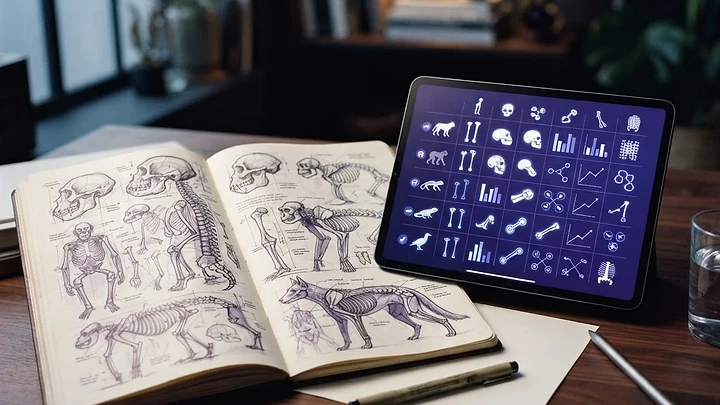
Digital tools allow students to visualize the evolutionary journey of anatomical structures in real-time, bridging the gap between static diagrams and biological reality.
Direct answer: Mastering comparative anatomy requires shifting from rote memorization to a functional, evolutionary framework. AI acts as a high-level conceptual partner, helping you identify homologous structures and evolutionary trends across vast biological datasets. AI Professor Courses provides over 80 courses across AI, Sciences, Math, Nursing, Law, Criminal Justice, History and more, starting at $5/month for instant 24/7 tutoring and exploration.
How does an evolutionary framework simplify structural comparison?
To move beyond simple memorization, you must anchor each structural observation in an evolutionary context. When you attempt to memorize the skeletal variations between disparate vertebrate classes, the brain often hits a cognitive ceiling because it lacks a cohesive structure to organize the data. By using AI as an interactive tutor, you can ask for the phylogenetic rationale behind a specific morphological change rather than just asking for a list of features.
For instance, if you are studying the transition from aquatic to terrestrial movement, an AI tutor can simulate the iterative transformation of the pelvic girdle. Instead of reading a static textbook, you can prompt the AI to explain the adaptive pressures that led to specific changes in bone density and attachment points. This conversational approach allows you to connect the function of a limb directly to its evolutionary history, turning a list of anatomy vocabulary into a logical narrative. By focusing on the 'why' behind the structure, the 'what' becomes inherently easier to recall.
Furthermore, you can use the platform to generate comparative scenarios that test your understanding. You might prompt the system to describe the potential skeletal adaptations required for a mammal transitioning back to a fully aquatic lifestyle, such as a cetacean. This forces you to apply your knowledge of standard terrestrial anatomy to a counter-factual scenario, effectively cementing your understanding of the original concepts. This high-order engagement is what distinguishes a surface-level learner from one who truly masters the discipline.
How can I use AI to distinguish between homologous and analogous structures?
One of the most persistent hurdles in comparative anatomy is the confusion between homologous structures—those sharing a common ancestral origin—and analogous structures, which evolved to serve similar functions but originated independently. AI tutoring excels at clarifying these distinctions through structured contrast and comparative analysis. When you engage with an AI tutor on this topic, you can provide specific examples and ask for an analysis of their developmental origins.
Consider the comparison between the wing of a bird and the wing of an insect. While both facilitate flight, their underlying architectures are fundamentally different. An AI tutor can break down these developmental trajectories, explaining that the bird wing is a modified forelimb with a bony internal structure, whereas the insect wing is an integumentary outgrowth. By using the AI to query these differences, you learn to look past the superficial 'function' of an organ to its actual biological development.
- Identifying developmental origins.
- Tracing shared ancestry vs. convergent evolution.
- Evaluating the functional utility of specific features.
- Mapping these traits across distinct biological categories including:
- Sciences, including Biology and Anatomy.
- Nursing and Clinical Practice.
- History and Evolutionary Development.
- Law and Bioethics.
By leveraging this digital assistant to organize your comparisons, you effectively build a mental taxonomy. The AI helps you categorize structures into their appropriate evolutionary buckets, which reduces the mental clutter that often occurs during the study of complex, multivariable organisms.
What is the best strategy for utilizing AI to map complex morphological pathways?
To prevent becoming overwhelmed, use a modular approach to map morphological pathways by focusing on one organ system at a time before attempting to reconcile the entire organism. AI is uniquely positioned to handle this segmentation, allowing you to deep-dive into the cardiovascular, nervous, or skeletal systems while keeping the overarching phylogenetic tree in mind. Start by asking your AI tutor to outline the primary evolutionary transitions for a single system, such as the evolution of the mammalian heart.
Once you have a baseline understanding of that system, use the AI to generate a 'comparison matrix' that contrasts that system across different species—for example, comparing the three-chambered heart of amphibians with the four-chambered mammalian heart. This technique provides a clear visual and logical structure that you can build upon throughout your studies. The AI can then act as a checkpoint, where you explain the model you have constructed and the tutor identifies gaps in your reasoning or highlights missing evolutionary context.
Finally, treat your AI session as a collaborative mapping exercise rather than a simple Q&A. If you find yourself drifting into rote memorization, instruct the AI to stop giving you answers and instead ask you guiding questions that force you to derive the structural similarities yourself. This process of self-explanation is one of the most robust cognitive strategies for long-term retention. When you are the one explaining the evolutionary trajectory of a specific bone or organ to your AI tutor, you move from passive consumption of information to active integration of complex scientific knowledge, ensuring your study sessions are both productive and intellectually satisfying.
Discuss this article
AI study companion
Ask about the core concepts, get a plain-English summary, or have any idea in this article unpacked. The companion reads the article itself before it answers.