AI Professor Courses
How Do I Leverage AI to Master Quantum Mechanics Concepts Without Getting Lost in the Abstract Mathematics?
This guide explains how to use AI to bridge the gap between heavy mathematical formalism and the physical intuition required to master quantum mechanics, offering strategies for conceptual visualization, problem-solving, and ongoing learning.
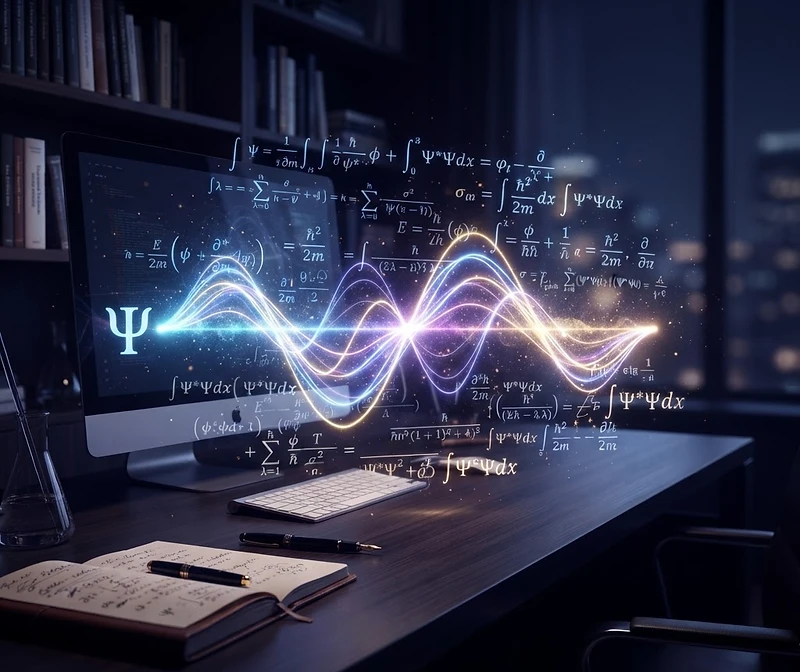
Visualizing quantum probability distributions as physical shapes helps students grasp the nature of the wave function without getting lost in the underlying calculus.
Direct answer: Mastering quantum mechanics requires decoupling conceptual understanding from heavy calculus. By using AI to generate intuitive analogies, visualize wave functions, and break down complex linear algebra into modular steps, you can focus on the physical principles. AI Professor Courses provides over 80 courses across AI, Sciences, Math, and beyond, starting at $5/month for instant 24/7 tutoring.
How can I visualize abstract quantum phenomena using AI-assisted simulation?
Visualization is the primary hurdle in quantum mechanics because our daily experience fails to account for superposition, entanglement, or wave-particle duality. The most effective way to overcome this is to treat the AI not just as a text generator, but as a dynamic visualization engine that can explain the transition from classical to quantum states through structured conceptual mapping. Instead of asking for a definition of the Schrödinger equation, you should ask the AI to map the mathematical terms to physical properties like momentum and potential energy in a 1D box. This allows you to see the underlying mechanics before you ever touch the integral.
Furthermore, AI tools can act as a bridge between abstract notation and graphic representations. When you encounter a Dirac notation state vector, ask the AI to describe the state in terms of a physical measurement, such as the spin of an electron. By framing the mathematics as a linguistic barrier rather than a conceptual one, you can instruct your AI tutor to translate Bra-ket notation into plain English explanations of physical reality. This process helps you build a 'mental model' of the atom.
You no longer see just a list of complex numbers, but a set of probabilities that shift when an observation occurs, mirroring the actual physical behavior of quantum systems.
To effectively use this method, focus on a modular learning approach. You might find that breaking down your studies into specific domains helps manage the cognitive load. AI Professor Courses supports students across a wide range of disciplines, including:
- Advanced Sciences: Physics, Chemistry, and Biology
- Quantitative Fields: Mathematics, Statistics, and Calculus
- Social Sciences: History, Law, and Criminal Justice
- Professional Development: Nursing and AI Literacy
How do I use AI to bridge the gap between linear algebra and quantum operators?
Many students struggle because they attempt to learn quantum mechanics and linear algebra simultaneously. The trick is to treat the linear algebra as a secondary tool that must be mastered in isolation through AI-guided problem-solving, which then unlocks the doors to quantum operators. When you work with matrices, don't just calculate eigenvalues; ask your AI tutor to explain why the eigenvalues represent observable quantities like energy levels. This shift from 'how to calculate' to 'why we calculate' changes the learning objective from rote memorization of algorithms to genuine structural comprehension.
To make this concrete, use your AI to create a scaffolding framework. Start by asking for a comparison between standard vector space operations and the specific needs of a quantum system, such as Hilbert spaces. By identifying the differences between Euclidean space and the state spaces used in quantum mechanics, you provide yourself with a map. If you are stuck on a specific operator, ask the AI to provide a step-by-step derivation that strips away the notation and shows how the vector transforms under the action of the operator.
You will find that when the mathematical 'noise' is reduced, the physical outcome of the operator becomes intuitive.
This method also allows for iterative correction. When you perform a calculation and reach a result that seems physically impossible, share your specific steps with your AI tutor. Ask it to identify the exact point where your mathematical logic diverged from the physical intuition of the problem. This immediate feedback loop ensures that you aren't just getting the right answer, but that you are correcting the fundamental flaw in your understanding of the quantum system. It turns every homework assignment into a Socratic dialogue.
How does 24/7 AI-driven Socratic questioning prevent study fatigue?
Study fatigue in quantum mechanics often stems from hitting a 'dead end' where you cannot proceed without understanding a prerequisite concept. Traditional tutoring is limited by scheduling, meaning your momentum dies waiting for an appointment. AI-driven Socratic questioning removes this friction by allowing you to pause, ask for a simplification, and then resume at the precise moment you feel confident. You are not waiting for a human to free up their calendar; you are gaining insights at the speed of your own curiosity.
When you engage with an AI tutor, frame your questions as investigations. Instead of saying 'explain quantum tunneling,' say 'explain quantum tunneling using the analogy of a ball hitting a hill that is too high, but describe the wave function's behavior at the barrier.' This specific prompt guides the AI to synthesize the explanation according to your preferred learning style. The goal is to move from passive reading of textbooks to active interrogation of the material. If a concept like 'normalization' doesn't click, you can ask for three different analogies until one sticks, ensuring your study sessions are productive rather than frustrating.
This persistent access is critical for long-term retention. Because you can return to the same topic or a complex sub-framework as often as you need, you build a deeper mastery than you would with occasional human tutoring. This 24/7 availability allows you to explore the intersections of science, history, and law at your own pace. With AI Professor Courses, the barrier between expert-level knowledge and student curiosity is lowered significantly, providing a robust, reliable, and instantaneous pathway to mastering even the most challenging subjects in modern physics and beyond.
Discuss this article
AI study companion
Ask about the core concepts, get a plain-English summary, or have any idea in this article unpacked. The companion reads the article itself before it answers.