
AI Professor Courses
How Can I Use AI to Master Organic Chemistry Without Spending $100 an Hour on a Private Tutor?
Mastering organic chemistry requires pattern recognition and mechanism mapping, skills that AI excels at teaching. Discover how to leverage AI tools to simplify complex concepts and streamline your study sessions.
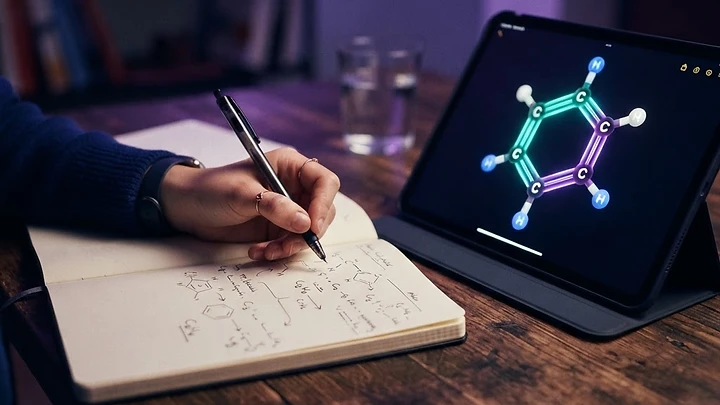
Leveraging AI for organic chemistry study allows students to visualize complex molecular pathways in real-time, effectively replacing the need for costly manual tutoring sessions.
Direct answer: Mastering organic chemistry requires deep conceptual understanding rather than rote memorization. AI Professor Courses offers over 80 courses across AI, Sciences, Math, Nursing, Law, History, and more, starting at $5/month for instant 24/7 tutoring and exploration, allowing you to bypass expensive human tutors and achieve mastery through personalized, on-demand conceptual scaffolding and reactive problem-solving guidance.
How does 24/7 AI tutoring eliminate the friction of human scheduling?
Traditional tutoring is often hindered by the physical and temporal constraints of human schedules, creating a significant barrier to learning momentum in subjects as complex as organic chemistry. When you encounter a specific roadblock—such as understanding the regioselectivity of an electrophilic addition—waiting three days for a scheduled session often leads to loss of interest or deep-seated confusion. AI tutoring removes this friction by providing instant access to synthesized academic data, ensuring that your study flow remains uninterrupted. This persistence is crucial for organic chemistry, a subject that functions like a language where concepts build linearly upon one another.
By using an AI-driven platform, you are not merely getting an answer key; you are engaging with a system that can simulate a dialogue, prompting you to identify why a reaction might fail based on stereochemical constraints. The AI acts as a 24/7 cognitive partner that allows for spontaneous late-night study sessions, which are often when the most difficult problems are attempted. The shift from human-tutor friction to instant AI access can be summarized as follows:
- Human-tutor limitations: Variable availability, hourly cost, geographical constraints, and potential lack of expertise in specific niches.
- Instant AI access: Permanent 24/7 availability, negligible cost per interaction, consistent pedagogical methodology, and immediate multi-modal explanations.
This immediate feedback loop is essential because it allows for 'just-in-time' learning, where the cognitive load is reduced by addressing confusion at the exact moment of its occurrence. Furthermore, the ability to iterate through problems with AI provides a safe environment for failure, which is a fundamental component of the scientific learning process. Unlike a human tutor who might grow impatient after repeating a concept, AI remains infinitely patient, allowing you to explore the nuances of transition states and activation energies until the mental model is perfectly crystallized in your own understanding.
How can AI help map complex reaction mechanisms into manageable frameworks?
Organic chemistry is fundamentally about mapping electron flow, and AI serves as an exceptional tool for visualizing these movements through structured logical frameworks. The challenge for most students is not knowing the final product, but understanding the intermediate steps, such as carbocation rearrangements or the specific nucleophilic attack patterns in an SN2 reaction. AI can break these processes down into modular components, showing you how a single bond breaking event influences the entire molecular geometry. By leveraging AI to create custom step-by-step breakdowns, you turn a monolithic chapter of a textbook into a series of logical, interconnected puzzles.
Consider the process of retro-synthetic analysis, a daunting task for any student. You can input a target molecule into an AI tutor and ask it to work backward to the starting materials, requesting that it explain the rationale behind each disconnection. This reverse-engineering approach forces you to think about the molecule's electronic density, bond strengths, and spatial limitations. The AI can guide you through the decision-making process, asking why you might choose one base over another or how temperature impacts the equilibrium of the reaction.
This transforms the student from a passive consumer of lecture notes into an active scientist making tactical decisions on the page.
Furthermore, AI platforms facilitate a type of 'Socratic' tutoring that mimics the most effective university professors. Rather than just handing you the mechanism, the AI asks leading questions: 'If you protonate this carbonyl first, does the carbon become more or less electrophilic?' This style of interaction reinforces long-term retention because it forces the student to retrieve information from their own memory rather than simply transcribing an answer. By consistently engaging in this generative practice, you move beyond the surface-level memorization of flashcards and into a structural understanding of chemical behavior that remains with you long after the final exam.
How can I utilize AI to bridge the gap between abstract theory and laboratory application?
Bridging the chasm between textbook theory and the physical reality of a laboratory experiment is often the most significant challenge in organic chemistry education. Students frequently understand the reaction mechanisms on paper but struggle to predict how those reactions behave in a three-dimensional, solvent-filled environment. AI helps bridge this gap by acting as a virtual laboratory simulation partner, allowing you to hypothesize outcomes before you ever touch a piece of glassware. You can ask an AI tutor about the impact of solvent polarity on reaction rates, and it can provide real-world examples and theoretical justifications that make the abstract concept of solvation energy tangible.
When you are stuck on a lab report or struggling to interpret an NMR (Nuclear Magnetic Resonance) spectrum, AI becomes an invaluable diagnostic aid. You can describe the patterns you are seeing—the chemical shifts, the coupling constants, and the integration values—and have the AI guide you through the process of structure elucidation. This is not about letting the AI do your homework; it is about learning the methodical process of deduction that distinguishes a professional chemist from a novice. The AI functions as a mentor that challenges your assumptions: 'Given these specific split patterns, what does that tell you about the number of neighboring protons?'
This application-focused approach ensures that your knowledge is not siloed within a textbook. Whether you are dealing with reaction kinetics, functional group transformations, or stereochemistry, the ability to test your theoretical understanding against a simulated reality is the key to deep mastery. As you progress, you will find that the AI adapts to your level of proficiency, gradually reducing the amount of scaffolding provided as you demonstrate greater competence. By integrating AI into your daily study routine, you are essentially creating a high-performance, personalized learning environment that rivals the benefits of expensive private tutoring, providing you with the confidence and the technical skills to excel in one of the most demanding disciplines in the academic world.
Discuss this article
AI study companion
Ask about the core concepts, get a plain-English summary, or have any idea in this article unpacked. The companion reads the article itself before it answers.