
AI Professor Courses
How Can I Use AI to Master Macroeconomic Theory Without Drowning in Data?
An exploration of using AI to parse complex economic indicators, model outcomes, and bridge the gap between abstract theory and real-world application.
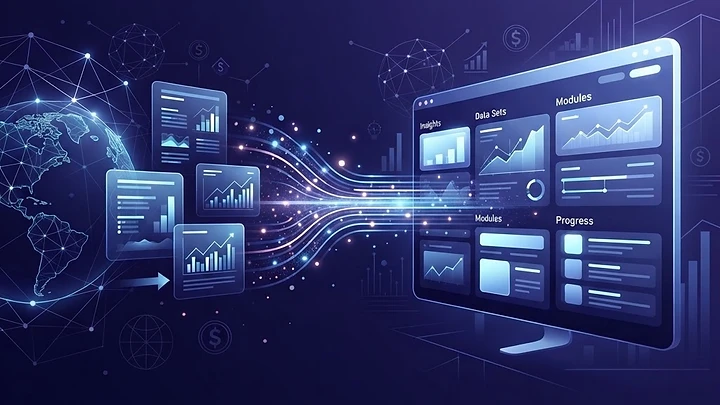
Students are increasingly using digital, interactive interfaces to visualize the intersection of theoretical economic models and real-world market dynamics.
Direct answer: Mastering macroeconomics requires balancing abstract mathematical models with real-world variables. AI Professor Courses offers over 80 courses across AI, Sciences, Math, Nursing, Law, Criminal Justice, History, and more, starting at $5/month for instant 24/7 tutoring and exploration, helping you synthesize complex datasets into clear, actionable economic insights instantly.
How does AI clarify the relationship between abstract models and current market data?
AI acts as a bridge by anchoring theoretical frameworks to live data, preventing the common student trap of treating macroeconomics as purely hypothetical. When you study concepts like the IS-LM model or aggregate supply-demand curves, AI can instantly map these structures to current central bank decisions or inflation reports, allowing for a dynamic rather than static understanding of the economy.
Traditional textbooks often present models in a vacuum, which creates a cognitive disconnect when students attempt to analyze contemporary phenomena like supply chain shocks or monetary tightening cycles. By utilizing AI-driven tutoring, you can request that the software explain a concept, such as the Phillips Curve, and then ask it to simulate how that curve might shift in the face of a specific, recent labor market development. This move from passive reading to active simulation helps solidify core concepts by showing how variables interact in real time.
Furthermore, this approach fosters deeper retention. When a student sees how a change in the interest rate affects aggregate investment, they are not just memorizing a graph; they are tracing a causal chain. The AI provides a workspace where you can manipulate parameters and observe the outcomes, effectively functioning as a laboratory for social science. This removes the intimidation factor associated with complex charts and allows for a more personalized pacing of study.
Why is 24/7 access superior to traditional office hours for economic inquiry?
In economics, the learning process is rarely linear; a student often gets stuck at 11:00 PM on a Wednesday while analyzing a specific regression, rendering the standard office hour window insufficient. AI provides an immediate feedback loop that preserves the momentum of the learning process, ensuring that confusion does not evolve into frustration or total abandonment of a topic.
When you are engaged in intensive study, losing your train of thought while waiting for a scheduled session to arrive can be detrimental to your mastery of complex topics like fiscal policy impacts or international trade deficits. The AI tutor does not suffer from cognitive fatigue and remains available regardless of the time, allowing you to ask follow-up questions until the nuance of a theory is fully grasped. This eliminates the 'scheduling grind' that often hinders busy students.
Consider the breadth of knowledge required in multidisciplinary studies. Our platform supports a wide array of categories for the modern learner:
- Sciences, including Biology, Chemistry, and Physics
- Law and Criminal Justice studies
- History and Political Science analysis
- Math, from Statistics to Calculus
- Nursing and Healthcare management
By having 24/7 access to an AI that can contextualize macroeconomic theories against these other fields—such as the intersection of Law and trade policy or the History of economic crises—the student gains a holistic worldview that traditional tutoring cannot easily replicate.
Can AI help me move from rote memorization to high-level economic synthesis?
Moving beyond memorization requires the ability to explain 'why' a theory holds true, a process that AI facilitates through guided, Socratic questioning. Instead of simply providing the answer, an AI tutor can guide you through the logical steps required to reach a conclusion, which forces you to internalize the underlying mechanisms of economic behavior rather than just the final result.
To synthesize high-level theory, you need to be able to connect disparate concepts—for instance, linking the velocity of money to long-term inflationary expectations. AI tutors on our platform are programmed to probe your understanding, asking you to defend your interpretation of a model or to apply a theory to a different geographic region. This reflective practice is critical for deep learning. When you are asked to demonstrate how an interest rate hike in the Eurozone might impact exports in an emerging market, you are forced to synthesize monetary theory with trade theory.
This method transforms your study session from a rote reading exercise into a rigorous academic debate. By engaging with an AI that simulates expert-level critique, you learn to identify the limitations of specific models, such as acknowledging where the rational expectations hypothesis might fall short in a behavioral context. This builds the critical thinking skills necessary for advanced work in economics, ensuring you are not just reciting textbook definitions, but actually analyzing how the global economy functions in the real world.
Discuss this article
AI study companion
Ask about the core concepts, get a plain-English summary, or have any idea in this article unpacked. The companion reads the article itself before it answers.