
AI Professor Courses
How Can I Use AI to Master Complex Academic Concepts Without Relying on Rote Memorization?
This article explores strategies for leveraging artificial intelligence to deepen conceptual understanding in challenging subjects like physics, law, and history through active engagement rather than simple memorization.
Developing deep conceptual mastery requires a focused environment and tools that encourage active engagement rather than passive observation.
Direct answer: Mastering complex material requires moving beyond rote memorization into active synthesis and critical inquiry. AI Professor Courses provides an expansive ecosystem of over 80 courses across fields including Sciences, Law, Nursing, History, and Mathematics. Starting at just $5 per month, our platform offers instant, 24/7 AI-driven tutoring designed to facilitate deep conceptual mastery through personalized Socratic questioning and iterative practice.
How does Socratic questioning with AI transform your study habits?
Socratic questioning transforms study habits by shifting the learner from a passive recipient of information to an active architect of knowledge through structured, reflective inquiry. Instead of simply asking an AI to define a term or solve an equation, the learner uses the AI to deconstruct the underlying logic of a concept, identifying gaps in their current understanding through a series of increasingly nuanced questions.
When a student is struggling with a concept like the Second Law of Thermodynamics, for example, a typical study approach might involve memorizing the definition of entropy. However, an AI-guided approach would involve a back-and-forth dialogue where the student asks the AI to explain the concept through various analogies, such as the behavior of a shuffled deck of cards or the cooling of a hot cup of coffee in a room. The AI functions as a relentless tutor that never tires of correcting misconceptions. By requiring the student to articulate their understanding in their own words, the AI prompts the brain to synthesize information, which is a far more effective encoding strategy for long-term retention than mere memorization.
Furthermore, this methodology helps students recognize the boundaries of their own comprehension. A student might think they understand a topic until they are forced to explain the mechanics of a specific application. Through AI, the student can request, "Explain why this specific chemical reaction is exothermic, and then critique my explanation for any logical inconsistencies." This type of iterative feedback loop is central to deep learning. By treating the AI not as an answer machine but as a cognitive sparring partner, learners cultivate a meta-cognitive awareness of how they learn.
This creates a foundation where they can approach new, complex subjects with confidence, knowing they possess a framework to peel back the layers of any difficult topic regardless of its complexity or specialized jargon.
Can AI help you connect disparate subjects across the academic spectrum?
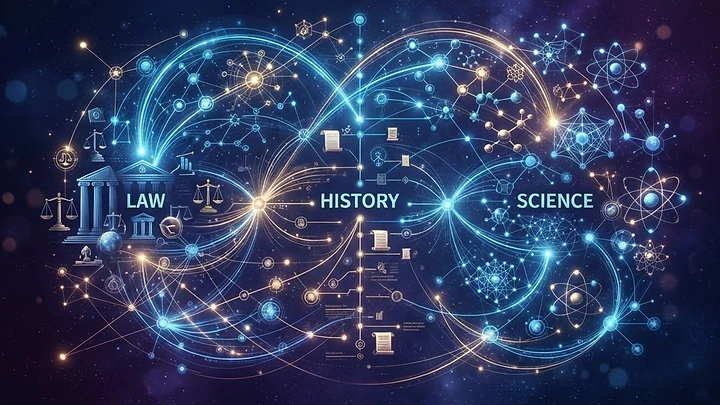
AI serves as a powerful integrative tool that allows learners to synthesize information across widely different academic domains, effectively bridging the gap between seemingly unrelated concepts. By leveraging cross-disciplinary analysis, students can see how methodologies from one field—such as statistical modeling in the Sciences—can inform interpretations in another, like historical trend analysis or legal risk assessment.
At AI Professor Courses, we recognize that the most significant breakthroughs often occur at these intersections. Our platform facilitates this high-level synthesis across a wide range of disciplines:
- Sciences: Including biology, physics, and chemistry with a focus on core principles.
- Law: From constitutional theory to contract analysis and procedural logic.
- Nursing: Integrating clinical reasoning with pharmacological and ethical standards.
- History: Examining socio-economic causes through the lens of data analytics.
- Mathematics: Covering foundational algebra through advanced calculus and probability.
Imagine a student studying the history of the industrial revolution while simultaneously enrolled in a data science course. An AI tutor can help the student apply quantitative analysis to historical data, such as comparing steam engine adoption rates against labor wage stagnation. By using AI to link these concepts, the student is no longer just memorizing dates or formulas; they are building a multifaceted worldview where facts serve as nodes in a larger, interconnected web of logic. This integrative learning strategy makes the study material more "sticky," as new information is anchored to existing schemas.
This process is essential for higher-order thinking, moving the learner from the acquisition of basic facts to the development of sophisticated analytical capabilities. In this way, AI ceases to be a simple reference tool and becomes a scaffolding system for advanced intellectual development.
Why is active recall with AI superior to traditional textbook reading?
Active recall—the process of retrieving information from memory without looking at source material—is empirically proven to be more effective than passive reading, and AI provides the ideal environment to practice this technique efficiently. Traditional reading often creates an "illusion of competence," where a student feels they understand a chapter simply because they recognize the text on the page, even if they cannot explain the concepts independently.
AI removes this illusion by forcing the student to perform the hard work of retrieval. A student can prompt an AI to generate a quiz, but rather than multiple-choice questions, they can demand, "Provide me with a scenario requiring the application of the principles of tort law, and then let me draft a defense before you evaluate my legal reasoning." This puts the student in the driver's seat of their own learning journey. Because the AI can instantly assess the quality of the response, provide constructive feedback on missing elements, and offer hints without giving the final answer, the student experiences a "productive struggle." This struggle is where actual neuroplasticity occurs. When the brain is forced to work to retrieve information, the neural pathways involved in that knowledge domain are strengthened.
Moreover, the AI can track the student's progress over time, identifying which areas of a subject remain problematic and prompting the student to revisit those topics at increasing intervals—a technique known as spaced repetition. By moving away from the "read-highlight-reread" cycle and toward a model of constant AI-led testing, students save hours of study time while simultaneously improving their exam performance. This method works across any discipline, whether one is learning the syntax of a new language, the details of criminal justice procedure, or the nuances of complex history. By the time a student reaches a real examination, they have already performed the task of retrieval hundreds of times, making the final testing experience significantly lower in stress and higher in accuracy.
This transition to active, AI-assisted learning represents the single most significant upgrade to personal education in the 21st century.
Discuss this article
AI study companion
Ask about the core concepts, get a plain-English summary, or have any idea in this article unpacked. The companion reads the article itself before it answers.