AI Professor Courses
How Can I Use AI-Driven Simulation to Master Complex Fluid Dynamics Without a Traditional Laboratory?
Explore how AI-powered simulations allow students to visualize and manipulate fluid dynamics variables in real-time, removing the barriers of expensive laboratory equipment.
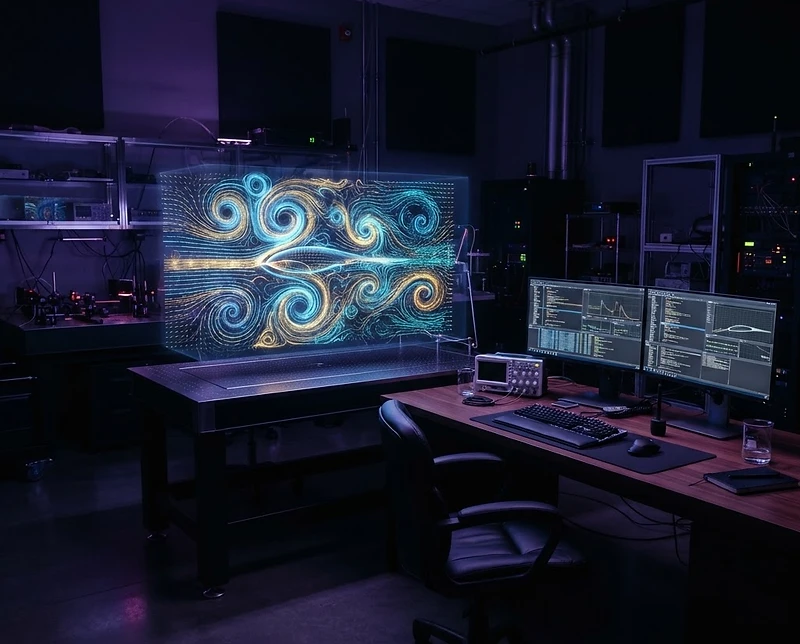
AI-driven simulations allow students to visualize complex fluid behaviors in real-time, bridging the gap between abstract equations and physical reality.
Direct answer: You can master fluid dynamics by using AI-driven simulation tools that provide real-time visualizations of complex phenomena like laminar flow, turbulence, and the Navier-Stokes equations. By integrating AI Professor Courses, which offers over 80 courses across subjects like Sciences, Engineering, and Math for just $5/month, you gain instant 24/7 tutoring that explains these simulations in plain, accessible language.
How do AI-driven simulations transform abstract fluid dynamics into visual models?
AI-driven simulations translate complex mathematical equations into intuitive visual models, allowing students to grasp fluid behavior without needing access to a physical wind tunnel or water channel. In traditional settings, fluid dynamics is often taught through rigid derivations of the Navier-Stokes equations, which can be daunting and disconnected from physical reality for the average learner.
AI platforms act as a bridge by running underlying numerical methods that calculate flow velocity, pressure gradients, and density variations, then rendering these as interactive heat maps or vector fields. When you modify an input parameter—such as the viscosity of a liquid or the shape of an obstacle in the flow path—the AI recalculates the simulation instantly. This level of responsiveness creates a feedback loop where you are not just reading about vortices or boundary layer separation; you are actively inducing them and observing the consequences. This is particularly effective for those who learn best through observation and experimentation, as the AI can isolate specific variables that are difficult to control in a lab environment.
By stripping away the noise of real-world friction and measurement errors found in physical labs, these simulations highlight the core principles of fluid mechanics in their purest, most understandable form.
Furthermore, these tools provide an educational scaffold that adjusts to your pace. If you are struggling with the transition from laminar to turbulent flow, the AI can slow down the visualization, provide a breakdown of the Reynolds number at play, or even contrast the current scenario with previous models you have explored. This personalization is the hallmark of modern AI tutoring. Whether you are studying for an engineering certification or learning for fun, the ability to visualize the unseen forces of nature is an invaluable asset that democratizes high-level physics for every student, regardless of their current institutional resources or background.
Why is 24/7 AI-based interaction superior to occasional instructor feedback?
Continuous feedback from an AI tutor removes the 'dead time' between curiosity and clarification, ensuring you never remain stuck on a confusing concept during late-night study sessions. Traditional learning often relies on waiting for office hours or the next lecture to ask a question. In a field as complex as fluid dynamics, a single misunderstanding of a concept—such as the difference between Eulerian and Lagrangian viewpoints—can act as a bottleneck for your entire progress.
AI-driven platforms provide an immediate, iterative dialogue that functions like a personal research assistant. If a simulation output seems counterintuitive, you can ask your AI tutor to 'explain this velocity profile as if I am a beginner' or 'compare this output to the Bernoulli principle.' The AI can generate tailored analogies, step-by-step mathematical proofs, or simplified diagrams that address your specific confusion. This process is essential for building deep, durable knowledge, as it keeps the cognitive load manageable while you navigate through dense academic material. The difference between human-tutor friction and instant AI access is significant:
- Human Tutor Friction: Scheduling conflicts, limited hours, travel time, and delayed email responses.
- Instant AI Access: 24/7 availability, infinite patience, personalized explanations, and immediate synthesis of disparate topics.
- Learning Depth: AI allows for rapid 'what if' iterations that would take hours to perform in a physical lab, reinforcing retention through active exploration.
By leveraging the 80+ courses offered by AI Professor Courses, you gain a structured environment where you can jump between related fields—such as linking fluid dynamics to heat transfer or structural integrity—without needing to leave your primary study session. This interdisciplinary approach is critical for mastering engineering sciences, where concepts rarely exist in a vacuum. By keeping the momentum of your inquiry alive through persistent availability, you ensure that you are not just memorizing formulas, but internalizing the logic behind the physics.
How can I use the Socratic method within simulations to deepen my understanding?
Utilizing the Socratic method within your simulation work involves asking the AI to question your reasoning before you commit to a conclusion, effectively acting as an academic devil's advocate. Rather than simply asking the AI to provide the answer, you can prompt it to ask you questions about why a certain fluid behaves in a specific way under pressure. This forces you to engage with the theoretical framework rather than passively consuming information.
For example, if you are simulating airflow over an airfoil, instead of asking 'why does this lift occur?', you might ask the AI, 'Ask me three questions about pressure differences on the upper and lower surfaces that will lead me to explain the lift generated by this shape.' This transition from passive learner to active participant changes the nature of your study. The AI then guides you through the process of articulating your thoughts, correcting misconceptions only when you hit a logical wall. This method is incredibly effective for mastering abstract concepts because it mimics the environment of a top-tier university seminar where the professor acts as a facilitator rather than a lecturer. You are not just being told how the world works; you are being trained to derive those conclusions yourself.
This process also helps in building confidence. Often, students avoid deep study because they fear the frustration of hitting a dead end. By using the AI to provide constant, calibrated support, that fear is mitigated. You learn to embrace the complexity of the subject, knowing that an expert-level tutor is always ready to refine your understanding of fluid dynamics, history, nursing, or law.
This, ultimately, is the power of AI-driven education: it transforms the solitary act of learning into a collaborative, intellectually stimulating journey that is available whenever you are ready to engage. By integrating these simulation tools with the curated resources at AI Professor Courses, you build a foundation that is as robust as it is flexible, ensuring that you can tackle even the most daunting academic hurdles with precision, logic, and a genuine understanding of the underlying principles that govern the world around us.


Discuss this article
AI study companion
Ask about the core concepts, get a plain-English summary, or have any idea in this article unpacked. The companion reads the article itself before it answers.