
AI Professor Courses
How Can I Use AI-Driven Scenario Modeling to Master Complex Supply Chain Logistics?
Learn how to leverage AI-driven simulation and scenario modeling to visualize, analyze, and master the intricate variables of global supply chain management for your studies.
Direct answer: Mastering supply chain logistics requires visualizing dynamic variables, from inventory flow to geopolitical disruptions. AI-driven scenario modeling allows you to simulate these complex systems in real-time, building deep intuition. AI Professor Courses offers over 80 courses across fields including Business, Sciences, and Math, providing instant 24/7 tutoring starting at $5/month.
Why does traditional textbook learning struggle with logistics complexity?
Traditional textbook learning often fails to capture the chaotic, interdependent nature of modern supply chain networks, leaving students with static theory instead of dynamic intuition. While core concepts like Economic Order Quantity (EOQ) or Just-in-Time (JIT) manufacturing are essential, they are traditionally taught as isolated mathematical formulas rather than interconnected, responsive systems. This abstraction creates a significant friction between the page and the reality of a globalized, data-heavy marketplace.
AI-driven platforms solve this by transforming static equations into live, interactive models. When you study a concept like the 'Bullwhip Effect'—where small fluctuations in retail demand cause increasingly larger swings in demand further up the supply chain—a textbook provides a graph. An AI tutor provides a sandbox. You can input variable shifts in supplier lead times or transport capacity and observe exactly how those ripples affect inventory levels across the entire chain in real-time. This active engagement shifts your cognitive load from memorizing formulas to understanding the underlying mechanics of system stability and risk mitigation.
Furthermore, AI platforms bridge the gap between academic theory and industry-standard modeling frameworks. By allowing you to simulate variables such as port congestion, raw material scarcity, or climate-related shipping disruptions, the AI acts as a mentor that challenges your assumptions. It asks, 'What happens if we increase safety stock by 10% versus diversifying our supplier base?' This interactive process forces you to integrate multiple disciplines simultaneously, helping you develop the high-level diagnostic skills necessary for professional logistics management. You no longer have to wonder if you understand the material; you can prove it by successfully navigating the simulation.
How can AI simulations help you visualize global network dependencies?
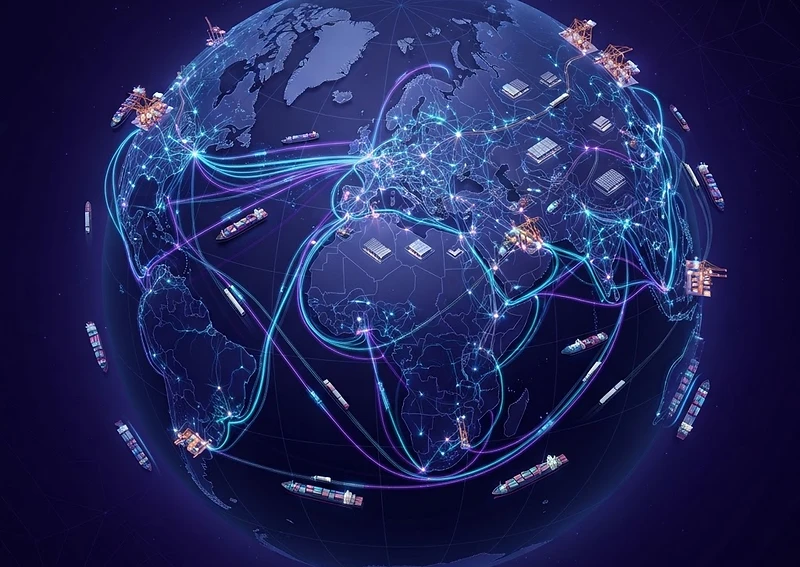
AI simulations enable students to visualize the hidden dependencies of global trade by creating spatial models that represent complex, non-linear supply networks. The primary challenge in logistics education is 'systems thinking'—the ability to see how an action taken in one continent impacts the availability of goods in another. AI bridges this gap by rendering these abstract connections visible and manipulable.
Consider the multi-modal transport challenges inherent in international trade. To understand the impact of a maritime blockage, you would traditionally study case reports after the fact. With AI-driven simulation, you can model a specific 'chokepoint' scenario where maritime traffic is diverted, and then observe the resulting delays in land-based warehousing and local distribution centers. You can see how the cost of goods sold increases, how lead times drift, and where the system reaches its breaking point. This visualization makes the invisible flows of global economy tangible.
This level of granular analysis is particularly useful when comparing different logistics methodologies:
- Lean Systems: Focus on minimizing waste and reducing inventory levels to the lowest possible threshold.
- Agile Systems: Prioritize responsiveness and speed, often requiring higher inventory buffers to handle volatile demand.
- Resilient Networks: Emphasize redundancy and multi-sourcing to ensure supply continuity during major global disruptions.
By running these scenarios side-by-side using AI tools, you learn the inherent trade-offs between cost and resilience. You move beyond basic definitions to a nuanced understanding of how to balance conflicting corporate goals. The AI tutor doesn't just provide the 'right answer'; it walks you through the optimization process, explaining why a specific strategy might fail in a high-volatility environment but succeed in a stable one. This process deepens your structural understanding of supply chains far more effectively than reading static case studies alone.
Can AI-driven Socratic questioning replace formal logistics case study analysis?
AI-driven Socratic questioning replaces passive reading with active, targeted inquiry, forcing you to defend your logistics strategies as if you were in a real board-level negotiation. Instead of reading a 30-page case study about a company's failure, the AI acts as your 'Devil's Advocate,' challenging you to explain why you chose a specific warehouse location or shipping lane. This creates an environment of high-stakes, low-risk experimentation that mimics professional experience.
When you engage in Socratic dialogue with an AI, it forces you to synthesize knowledge across disparate fields, including finance, operations, and law. For example, if you suggest moving production to a lower-cost region, the AI might prompt you to account for hidden costs like increased transit times, customs clearance complexities, and exchange rate volatility. It will continue to press you for data, requiring you to justify your logistics strategy based on specific Key Performance Indicators (KPIs). This iterative cycle of questioning ensures you aren't just reciting definitions; you are actively building a coherent, defensible strategy.
This method also helps you identify gaps in your own knowledge that you might have otherwise ignored. If you find yourself unable to answer why a particular risk-mitigation strategy is economically viable, the AI can pause to provide a deep-dive tutorial into that specific sub-topic. This on-demand, targeted instruction is far more efficient than searching through textbooks or online forums. It creates a personalized learning trajectory that meets you exactly where your understanding is currently lacking, providing the conceptual depth needed to master complex logistics without the overwhelm of traditional, linear curriculum design.