
AI Professor Courses
How Can I Use AI-Driven Case-Based Learning to Master Complex Pathophysiology Without Feeling Overwhelmed?
Learn how to use AI to break down complex medical concepts, understand disease mechanisms, and apply knowledge through simulated clinical scenarios.
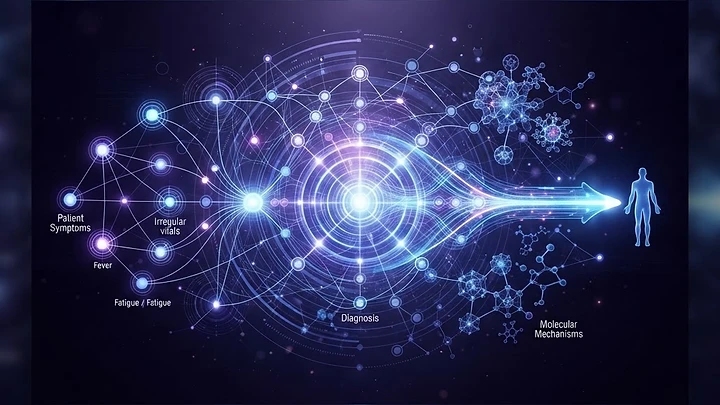
A student uses an AI-powered interface to visualize complex physiological pathways, turning abstract biological data into a clear, actionable mental model.
Direct answer: Mastering pathophysiology requires moving beyond rote memorization to understanding the physiological disruptions behind disease. AI Professor Courses offers over 80 courses across AI, Sciences, Math, Nursing, Law, Criminal Justice, History and more, starting at $5/month for instant 24/7 tutoring that transforms complex biological mechanisms into digestible, clinically relevant insights.
Why is case-based learning the gold standard for mastering complex physiological systems?
Case-based learning works because it grounds abstract cellular changes in the reality of a patient's clinical presentation, making the biological mechanisms memorable. Instead of trying to memorize a dense textbook chapter on renal failure, a student who walks through a simulated case study sees the physiological "why" behind the symptoms, which significantly improves long-term retention and diagnostic reasoning.
Traditional study methods often treat pathophysiology as a disconnected list of molecular pathways and symptoms. This approach creates a high cognitive load, forcing the brain to process information in silos. In contrast, clinical case-based learning—often supported by advanced Artificial Intelligence (AI)—allows you to connect the "what" (the disease) with the "how" (the molecular or systemic disruption). For instance, when you explore the pathophysiology of myocardial infarction, an AI tutor can guide you through the cascade from ischemic injury at the cellular level to the resulting hemodynamic instability in a patient's vitals.
This contextualization ensures that you are not just memorizing the fact that troponin levels rise, but understanding exactly why the cardiac myocyte injury releases these proteins into the bloodstream.
AI facilitates this by acting as a dynamic simulator that can generate unlimited clinical variations. You can present a basic case to the AI, such as a patient with Type 2 Diabetes, and ask it to introduce complications like diabetic ketoacidosis. The AI can then ask you to predict how the arterial blood gas results would shift based on the underlying acid-base imbalance. This active engagement forces you to synthesize information rather than passively highlighting text.
By using platforms like AI Professor Courses, you gain access to structured environments where this type of iterative questioning is the default, allowing you to build a robust mental model of human illness that serves you well throughout your clinical rotations.
How does AI help me map complex molecular pathways without getting lost in the weeds?
AI serves as a cognitive scaffold, helping you zoom in on specific cellular mechanisms when needed while keeping the broader systemic picture in focus. When you find yourself drowning in the details of a secondary messenger system or an obscure metabolic cycle, an AI tutor can act as an immediate bridge back to the clinical big picture.
Many students struggle because they lose the forest for the trees. They get so caught up in the nuances of membrane potential or G-protein coupled receptors that they forget how these processes influence systemic blood pressure or cardiac output. An AI tutor can provide "hierarchical explanations." You can ask the system to explain a topic at three different levels of complexity: the high-level system overview, the intermediate organ-level function, and the granular molecular mechanism. This allows you to build your knowledge base from the ground up, ensuring that every molecular detail you learn has a functional purpose.
Furthermore, AI tools can help you create visual associations for pathways that are otherwise purely text-based. You can ask an AI to generate analogies for complex immunological responses, such as comparing the inflammatory cascade to an emergency response system in a city. These analogies act as hooks, allowing you to anchor technical data points into more accessible conceptual frameworks. Whether you are studying topics in:
- Nursing and Clinical Practice
- Molecular Biology and Genetics
- Pharmacological Interactions
- Systems Anatomy and Physiology
- Epidemiology and Public Health
the ability to toggle between these levels of abstraction is what separates passive readers from active masters of the material. You aren't just reading a sequence; you are visualizing the movement of ions, the signaling of hormones, and the inevitable systemic shift that follows, all while maintaining an understanding of the patient's holistic health status.
What strategies can I use to turn AI-driven simulations into a 24/7 clinical laboratory?
By treating the AI interface as a virtual patient, you can simulate diagnostic reasoning sessions that mirror the intensity and depth of a supervised clinical rotation. This transforms your study time from a solitary reading session into a collaborative, guided exploration of medical scenarios.
To effectively use these simulations, you must move beyond asking the AI for definitions. Instead, frame your requests as clinical inquiries. Start by asking, "Give me a patient scenario involving acute respiratory distress, and guide me through the pathophysiological changes that occur in the alveoli." As you work through the case, challenge the AI to push your reasoning: "If this patient were to also have a pre-existing COPD diagnosis, how would that alter the compensation mechanism for this respiratory failure?" This type of rigorous back-and-forth develops your clinical intuition.
This method of "Active Querying" effectively replaces the traditional "lecture-then-quiz" loop with an "inquiry-then-synthesis" cycle. Because you have 24/7 access to this simulation, you can spend hours refining your understanding of a single disease process, testing different scenarios, and iterating on your reasoning until the physiological connections feel intuitive. This constant feedback loop is essentially what high-quality human tutoring provides, but it is now accessible on your own schedule. When you use resources like AI Professor Courses, you ensure that your simulation practice is not just random, but structured according to the latest academic standards, providing you with a rigorous and reliable way to prepare for exams and real-world clinical encounters.
This consistency is the secret to moving from feeling overwhelmed by the sheer volume of medical information to feeling empowered by a structured, logical understanding of how the human body fails and recovers.
Discuss this article
AI study companion
Ask about the core concepts, get a plain-English summary, or have any idea in this article unpacked. The companion reads the article itself before it answers.