
AI Professor Courses
How Can I Use AI-Assisted Concept Mapping to Synthesize Multidisciplinary Research?
Learn to leverage AI tools for high-level information synthesis by creating dynamic concept maps, transforming chaotic study notes into structured, meaningful academic frameworks.
Digital concept mapping allows students to visualize complex relationships between diverse academic topics, transforming isolated facts into a unified network of understanding.
Direct answer: You can master complex synthesis by using AI to identify latent connections between disparate research topics and visualizing them through dynamic concept mapping. AI Professor Courses supports this journey with over 80 courses across AI, Sciences, Math, Nursing, Law, History and more, starting at $5/month for instant 24/7 personalized learning.
Why is linear note-taking failing your research process?
Traditional linear note-taking—writing line by line in a notebook or document—fails to capture the multidimensional nature of academic inquiry, which is why AI-assisted concept mapping is the modern solution. Most students encounter difficulty when trying to synthesize information from diverse sources like a History textbook, a Nursing case study, and a legal brief simultaneously. When you record these points linearly, you lose the spatial relationships that define how these subjects influence one another. AI bridges this gap by acting as a connective tissue that processes your raw data and identifies the non-linear links that your brain might miss during an initial read-through.
By offloading the organization to an AI model trained in critical synthesis, you reclaim your mental energy for higher-order thinking rather than manual cataloging.
Consider the friction between human manual effort and AI efficiency. A human researcher might spend three hours manually tagging notes and shuffling index cards to identify themes in a complex research project, whereas an AI system can analyze the semantic density of these documents in seconds. This speed allows for iterative refinement, where you can ask the model to re-map based on different variables, such as comparing a historical event's economic impact versus its social aftermath. The transition from static notes to dynamic, interactive maps allows for a form of 'observational synthesis' that was previously reserved for advanced doctoral candidates.
By moving away from rigid, page-by-page capture, you create a living library of knowledge that grows alongside your course curriculum, ensuring that every snippet of information you consume is immediately integrated into your larger understanding of the subject matter.
How do you structure an AI prompt for conceptual synthesis?
To derive meaningful concept maps from AI, you must move beyond generic requests and utilize a structured, role-based prompting framework that treats the AI as a high-level academic assistant. Instead of simply pasting a paragraph and asking for a summary, you should provide the AI with a specific 'synthesis persona' and a target output format that highlights relationships rather than just definitions. For example, by telling the AI to 'Act as a research synthesist, identify three core thematic pillars connecting these disparate documents, and output the relationships in a hierarchical node-based format,' you force the system to categorize information by significance. This creates a scaffolding of knowledge that identifies the 'spine' of your topic, allowing you to branch out into supporting details without losing the thematic thread.
Effective prompts for this process generally follow a three-part structure: defining the objective, providing the context of the source materials, and stipulating the connective logic. Here is a framework you can adapt for your studies:
- Define the Scope: Tell the AI the academic level, such as undergraduate chemistry or constitutional law, to ensure the depth is appropriate.
- Set the Relationship Rules: Specify that the AI should link concepts based on causality, chronological influence, or categorical similarity.
- Request Visual Hierarchies: Ask for a structured list or a Mermaid-compatible markdown syntax that defines nodes and edges, effectively turning your notes into a navigable map.
This structured approach prevents the AI from delivering superficial bullet points and encourages it to synthesize the actual underlying arguments within your texts. By consistently applying this framework across your academic work, you will find that your ability to retain and relate information improves significantly, turning even the most dense and opaque research materials into clear, actionable knowledge paths.
Can AI mapping help bridge gaps between distinct academic subjects?
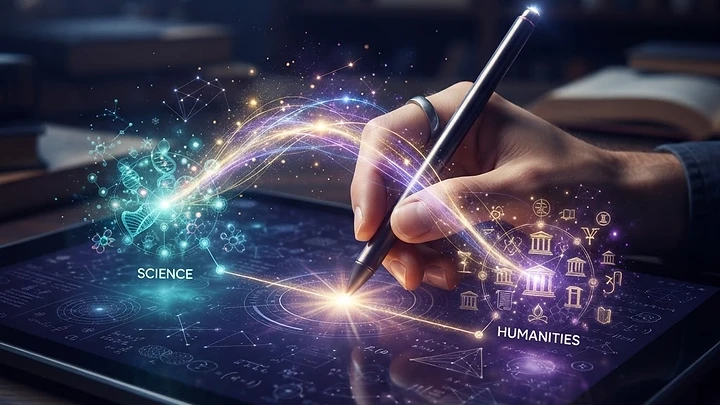
AI-assisted mapping excels at cross-pollinating ideas between fields that are traditionally taught in silos, such as how historical events in the 19th century created the regulatory frameworks found in current law. When you attempt to synthesize knowledge across disciplines, the biggest barrier is language—the way a Scientist describes a process is fundamentally different from how a Historian or a Jurist describes it. AI acts as a translation layer, mapping the terminology of one discipline into the conceptual framework of another. This allows you to build 'interdisciplinary bridges' where concepts like systemic risk in Finance are mapped to similar concepts in Public Health or Environmental Science.
By visualizing these intersections, you identify universal patterns that make mastering complex, disparate topics significantly more efficient.
This capability is particularly vital for students navigating multidisciplinary degree paths. When you use AI to identify these cross-subject connections, you aren't just memorizing facts; you are building a mental model of how the world functions, which is the hallmark of true expertise. Imagine being able to see a concept like 'entropy' not just in a physics class, but as an analogy for organizational decay in a History or Business course. This is not just a study tactic; it is a way of synthesizing information that makes your academic output more original and nuanced.
By identifying the underlying commonalities through AI-driven node mapping, you transform your learning from a collection of isolated facts into a robust, interconnected network of knowledge. This practice builds a depth of understanding that serves you well beyond the classroom, enabling you to synthesize complex problems in real-world scenarios long after you have completed your degree. As you explore these connections, you will find that your confidence in tackling unfamiliar, complex subjects increases, as you no longer look for the 'right answer,' but for the logical relationship between concepts.

Discuss this article
AI study companion
Ask about the core concepts, get a plain-English summary, or have any idea in this article unpacked. The companion reads the article itself before it answers.