

AI Professor Courses
How Can I Effectively Use AI to Reverse-Engineer Complex Mathematical Proofs?
Master the art of mathematical logic by using AI as a Socratic tutor that breaks down complex theorems into step-by-step components without skipping the foundational reasoning.
A structured, quiet learning environment combined with AI-assisted logical mapping is essential for mastering complex mathematical proofs effectively.
Direct answer: You can master complex mathematical proofs by using AI to decompose abstract theorems into fundamental logical steps. Instead of asking for an answer, prompt the AI to explain the underlying axiom behind each line of a proof. AI Professor Courses provides over 80 expert-led courses—including Advanced Mathematics, Sciences, and Engineering—starting at $5/month for 24/7 personalized tutoring.
How does Socratic questioning help you dissect a difficult proof?
The most effective way to use Artificial Intelligence (AI) for mathematics is to transition from a passive receiver of information to an active investigator using the Socratic method. By asking the AI to guide your reasoning rather than provide the conclusion, you force your brain to engage with the logical architecture of the theorem, which is essential for long-term retention and conceptual understanding.
When faced with a complex proof, such as the Intermediate Value Theorem or a specific derivation in linear algebra, students often fall into the trap of reading the proof from start to finish without verifying why each step follows from the previous one. To combat this, you should input the proof into your AI tutor and instruct it to act as a mentor. Begin by asking the AI to identify the primary goal of the proof and the initial assumptions required. For each subsequent line, pause and ask the AI, "Why is this algebraic transformation valid here?" or "Which theorem allows this substitution?"
This approach turns a daunting wall of symbols into a series of manageable logical gates. As you move through the proof, you will find that the AI provides clarity on ambiguous notation, which is often the primary source of frustration in higher-level mathematics. By requiring the AI to define the context of each step, you bridge the gap between abstract symbols and concrete logic. This is the exact philosophy we utilize at AI Professor Courses, where our platform supports diverse disciplines including:
- Advanced Calculus and Real Analysis
- Linear Algebra and Discrete Mathematics
- Organic Chemistry and Biochemistry
- Legal Analysis and Criminal Justice
- Historical Primary Source Interpretation
By treating the AI as a collaborator, you develop a mental map of how professional mathematicians construct proofs, which is an invaluable skill that serves you far better than memorizing the final result. The goal is to reach a point where you can reconstruct the proof from memory without assistance.
Can AI help you identify the common logical pitfalls in advanced mathematics?
AI is exceptionally skilled at identifying common misconceptions and logical fallacies that often trip up students when they attempt to prove complex mathematical statements. By explicitly asking an AI tutor to point out where a "naive" proof might fail, you gain a deeper appreciation for the rigor required in formal mathematical discourse.
When you are working through a proof, it is helpful to propose a "conjecture" or a proposed intermediate step to your AI tutor and ask, "Does this step follow logically, and are there any edge cases where this statement might be false?" This is particularly useful in areas like set theory or topology, where intuition often leads students astray. The AI can act as a stress-tester for your logic, offering counter-examples that reveal the nuances of a theorem. For instance, if you are working on a proof involving convergent sequences, the AI can show you how the proof would break down if a specific condition—like the boundedness of the sequence—were removed.
This process of "destructive testing" is how mathematicians refine their craft. By seeing the proof from the perspective of what it is not, you gain a much clearer understanding of why it is. The AI serves as a tireless partner that can simulate these scenarios in seconds, providing a depth of feedback that would typically require hours of office hours with a busy professor. Using this method transforms your study sessions from a frantic search for answers into a sophisticated exercise in mathematical verification, ensuring you understand the "why" behind the "what."
How can you move from understanding a single proof to mastering a mathematical framework?
Mastery in mathematics is not about knowing individual proofs; it is about recognizing the underlying structures that appear across different mathematical domains. You can use AI to synthesize multiple proofs into a cohesive framework, allowing you to see patterns that tie different chapters of your textbook together.
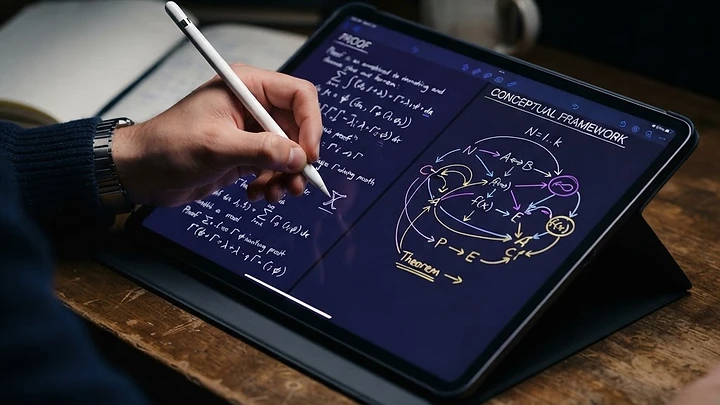
Once you have dissected several individual proofs, ask your AI tutor to help you build a "conceptual map." For example, if you have studied the Fundamental Theorem of Calculus, ask the AI, "How does the logic used in this proof relate to the Mean Value Theorem?" By prompting the AI to highlight commonalities in the reasoning techniques used across different chapters, you start to move from rote memorization to true mathematical fluency. This helps you develop the "mathematical intuition" that separates high-performing students from the rest of the class.
Furthermore, you can use the AI to generate practice variations of a proof, changing one variable or constraint, and then attempting to prove the new version yourself. If you get stuck, the AI remains ready to offer a hint or a nudge in the right direction. This iterative process of "prove, refine, and generalize" is the gold standard for learning mathematics. At AI Professor Courses, our pedagogical design is built around this exact principle, ensuring that our students do not just memorize facts but gain a structural understanding of their chosen field.
Whether you are studying the evolution of historical policies, the complexities of nursing pharmacology, or the nuances of abstract algebra, our 24/7 support ensures you have the guidance to move beyond simple recall to true mastery. By utilizing the AI as a scaffold for your own intellect, you can dismantle the barrier between "feeling lost" and "feeling capable," ultimately allowing you to tackle even the most rigorous coursework with total confidence and clarity.

Discuss this article
AI study companion
Ask about the core concepts, get a plain-English summary, or have any idea in this article unpacked. The companion reads the article itself before it answers.