
AI Courses · AI Courses Bundle
How Do I Successfully Retain Complex Technical Concepts Using AI-Adaptive Learning?
This guide explores how AI-adaptive learning platforms help students master challenging technical topics. It explains why traditional methods often fail and provides a pathway for utilizing AI professors to optimize long-term memory retention and conceptual clarity.
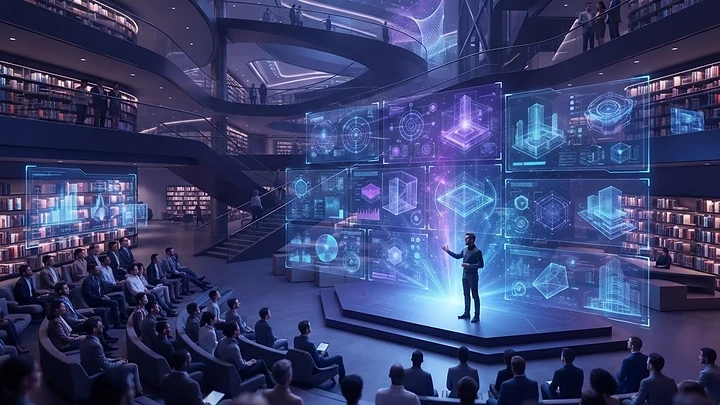
A personalized digital learning environment helps students visualize complex relationships between ideas, making abstract technical concepts much easier to grasp.
Direct answer
You can master complex technical concepts by using an AI-Adaptive Learning platform. Our AI professor course adapts to your unique pace and existing knowledge, identifying gaps in real-time. This 24/7 personalized instruction ensures you understand every core concept deeply. For just $5/month, you gain access to high-quality, tailored educational experiences.
Why do traditional study methods often lead to poor retention of technical concepts?
Traditional study methods rely on linear, one-size-fits-all curricula that force every student to learn at the same pace. When a learner encounters a complex technical topic, such as advanced physics or programming architecture, the static nature of textbooks or lecture videos means they cannot ask for clarification or deeper context. If a foundational concept is missed, the learner carries that gap forward, leading to a collapse of understanding as the material increases in complexity. This creates a cycle where students memorize formulas without comprehending the underlying principles.
Memory retention in technical subjects is fundamentally tied to the spacing effect and active recall. When students simply re-read notes, they engage in passive learning, which gives a false sense of competency. True retention requires that a student interacts with the material, makes mistakes, and receives immediate, constructive feedback. Traditional classrooms or self-study modules rarely provide this level of personalized interaction, leaving students to struggle alone.
- Linear content delivery creates knowledge silos.
- Passive reading fails to stimulate neural pathways for long-term storage.
- Lack of immediate feedback leads to the reinforcement of incorrect assumptions.
- Fixed pacing fails to account for individual learning velocities.
To improve retention, one must shift from passive consumption to active, recursive study patterns. Imagine you are studying data structures. Instead of reading a chapter once, you should break it down into modular concepts: arrays, linked lists, and trees. By assessing your understanding of arrays before moving to trees, you build a stable foundation.
AI-adaptive systems facilitate this by forcing you to prove mastery at each stage. They treat learning as a dynamic graph rather than a straight line. When you stumble, the system adjusts the curriculum, providing a new perspective or a different set of examples until the lightbulb finally goes off. This method transforms "studying" from a chore into a process of progressive mastery, ensuring that your foundation is rock solid before you reach for more advanced abstract theories.
How does an AI professor teach technical subjects differently than a human tutor?
An AI professor utilizes adaptive algorithms to model your knowledge state in real-time, providing a level of granular personalization that a human tutor, burdened by time and fatigue, simply cannot match. While a human might explain a concept in two or three ways, an AI professor can iterate through hundreds of pedagogical approaches based on what you find most intuitive, such as visual analogies, mathematical proofs, or practical code implementations.
Furthermore, the AI professor is never tired and never judgmental. Learners often hesitate to ask "stupid" questions for fear of appearing incompetent, but the AI removes this social pressure. By maintaining a continuous log of your progress, the AI can perform a phenomenon known as "long-term memory reinforcement." It knows exactly which topics you struggled with three weeks ago and will weave those concepts into your current lessons to ensure they stay fresh in your mind. This creates a cohesive learning narrative that connects your past lessons with your future goals.
- Non-judgmental, 24/7 availability reduces performance anxiety.
- Real-time data tracking identifies subtle knowledge gaps before they grow.
- Personalized analogies bridge the gap between abstract theory and reality.
- Instant, context-aware explanations provide clarity the moment confusion strikes.
Consider the "Feynman Technique" as a practical framework for using an AI professor. First, select a concept you are struggling with. Second, explain the concept to the AI professor as if you were teaching it to a beginner. Third, if you get stuck, ask the AI to identify the exact point in your explanation where your logic breaks down.
Fourth, refine your explanation. The AI professor will act as a Socratic mirror, asking you probing questions that force you to confront your own misunderstandings. By integrating this active teaching strategy with AI-driven content delivery, you bypass the trap of superficial memorization. The AI ensures that you are not just reciting facts, but truly internalizing the structural logic behind the technical subject matter.
What specific features define effective AI-adaptive learning for technical mastery?
Effective AI-adaptive learning is defined by three pillars: diagnostic assessment, dynamic path adjustment, and spaced repetition. Diagnostic assessment is the initial process where the system benchmarks your current level of understanding. Instead of starting at chapter one, the system identifies your existing strengths and weaknesses, allowing you to focus your limited energy on the areas that actually require improvement. This efficiency is the cornerstone of mastery.
Dynamic path adjustment means the curriculum is not fixed. If you master a sub-topic quickly, the AI skips the repetition. If you struggle, the AI introduces a "micro-lesson" that provides remedial context. This is coupled with spaced repetition, where the system monitors your forgetting curve. It schedules reviews of critical information just as you are about to lose it, effectively moving information from short-term memory to long-term synaptic storage. This is a scientific approach to learning that treats your brain like an asset to be optimized.
- Initial diagnostic tests prevent redundant study time.
- Intelligent content branching creates custom learning paths for every user.
- Automated spaced repetition schedules reviews for optimal memory retention.
- Micro-lessons provide instant support for specific confusion points.
For example, if you are learning a programming language, the AI might detect that you understand loops well but fail on recursive functions. Instead of making you re-read everything about the language, it presents a challenge specifically focused on recursion. It provides a worked example, then a blank-slate exercise. If you fail the exercise, it doesn't just show you the answer; it breaks down the stack trace and asks you to correct your logic.
This iterative loop is how professionals learn. By treating these interactions as a form of "deliberate practice," you ensure that your progress is measurable and that your technical skill set is built on actual comprehension rather than rote memorization. The AI provides the infrastructure for this practice, but you are the one building the mental model.
Can a $5/month AI course actually provide the depth required for advanced study?
Yes, the power of a $5/month AI-adaptive course lies in the scalability of high-quality instruction. By leveraging artificial intelligence, we remove the overhead of physical infrastructure, administrative costs, and the hourly wage of private tutors. This allows us to deliver a premium educational experience that is accessible to everyone. The depth is found not in the price tag, but in the quality of the content and the precision of the AI professor's delivery mechanism.
Many learners equate cost with quality, but in the digital age, access is the true equalizer. A $5/month subscription is not about cutting corners; it is about utilizing modern technology to make world-class learning modular and continuous. You get access to the same rigorous curriculum design that elite students receive, with the added benefit of an AI tutor that is dedicated exclusively to your personal learning speed and specific cognitive requirements. It is a high-leverage investment in your professional capabilities that pays dividends in skill acquisition and conceptual depth.
- Subscription model democratizes access to high-tier academic resources.
- Leverages AI to provide expert-level pedagogical feedback at scale.
- Lower costs allow for sustained, long-term learning without financial fatigue.
- Eliminates the barrier between high-quality education and economic constraints.
To get the most out of your $5/month investment, you should treat the course as a continuous professional development tool. Instead of trying to "finish" a course, aim for "mastery cycles." Spend thirty minutes a day interacting with the AI professor. Use the time to tackle the hardest problems first, while your mind is fresh. If you encounter a complex topic, lean into the AI's ability to simplify it for you.
Ask for deeper examples, more complex cases, or historical context. By constantly pushing the boundaries of what you know, you will discover that the platform is deep enough to support you from beginner status to advanced proficiency. Your monthly investment grants you the key to a library of knowledge that is constantly updated to meet the current standards of technical excellence.

By the numbers
The picture at a glance.
The Power of Adaptive Learning
AI-driven education is significantly more efficient than traditional, one-size-fits-all classroom methods.
Learning Accessibility
Removing barriers to high-quality education through technology ensures consistent progress for all learners.
Side by side
How the options compare.
Learning Method Comparison
| Method | Personalization | Availability | Relative Cost |
|---|---|---|---|
| AI Professor | High | 24/7 | Low |
| Live Tutor | High | Limited | High |
| Textbook | None | 24/7 | Medium |
| Classroom | Low | Fixed | High |
Retention Strategies
| Technique | Effort | Retention Impact | AI Support |
|---|---|---|---|
| Active Recall | High | Strong | Automated |
| Spaced Repetition | Medium | Strong | Built-in |
| Passive Reading | Low | Weak | None |
The data
What the numbers look like.
Comparative Study Efficiency
AI-adaptive learning reduces the total time required to reach mastery compared to traditional study.
Hours per week
Monthly Cost Comparison
Affordable access to high-quality technical education through modern AI subscription models.
USD per month
Enrol
Start today.
AI Courses Bundle is taught by an AI professor that adapts to what you already know, available 24/7, from $5/month.