Special Interest Courses · AI Makeup Artist Professor
How Do I Master Professional Makeup Artistry Techniques Without Attending Expensive Schools?
This guide explores effective methods for learning professional makeup artistry through AI-assisted platforms, focusing on skill acquisition, technique refinement, and cost-effective digital training that provides personalized feedback for aspiring makeup artists.
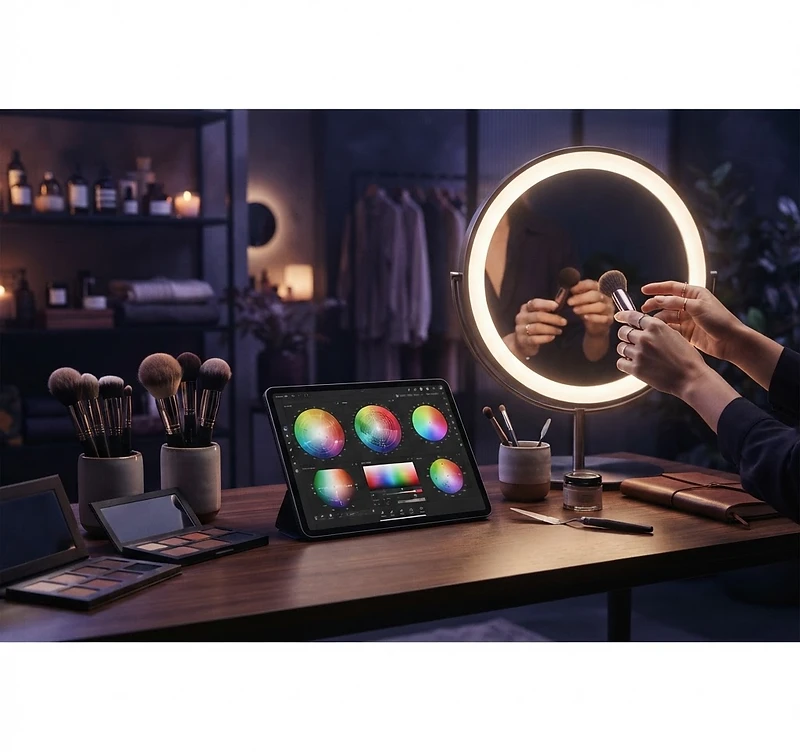
A well-equipped workspace represents the blend of traditional artistry and modern digital instruction needed for success.
Direct answer
You can master professional makeup artistry by enrolling in the AI Makeup Artist Professor, a course taught by an AI professor. It uses AI-Adaptive Learning to tailor lessons to your specific skill level and is available 24/7. This comprehensive program provides expert-level instruction for just $5/month.
How does an AI professor teach makeup artistry differently?
An AI professor teaches makeup artistry by analyzing your progress in real-time, adjusting the complexity of lessons based on your demonstrated proficiency rather than following a rigid, one-size-fits-all curriculum. This approach mimics the personalized attention of a private mentor while allowing you to practice at your own pace.
Traditional instruction often moves at the speed of the slowest student in a class, which can be frustrating for those who grasp techniques quickly or demoralizing for those who need more time on specific skills. In contrast, the AI Makeup Artist Professor identifies where you are struggling—perhaps with color theory or precise eyeliner application—and offers supplemental drills designed to strengthen those specific areas. This granular feedback loop ensures that no technique is left unmastered.
Furthermore, the curriculum is structured to emphasize mastery through repetitive, incremental gains. Instead of long lectures that are hard to digest, the AI breaks down the art of professional makeup into manageable micro-lessons. For example, if you are learning how to contour, the system will first test your understanding of facial bone structure, then move to cream product blending, and finally progress to powder setting techniques. By segmenting the learning process, the AI prevents information overload and builds a solid foundation of muscle memory.
This modular approach is particularly useful for artists trying to balance training with a professional life.
Consider a scenario where you are struggling to blend eyeshadow smoothly. A human teacher might only see the final result once a week. An AI-adaptive system can provide instant visual guidance, identifying common mistakes like harsh lines or uneven pigmentation, and suggesting specific brush angles or pressure adjustments to correct the error immediately. This constant stream of corrective information accelerates the learning curve significantly.
You move through the basics of color harmony at your own speed, spending less time on concepts you already intuitively understand and more time on the technical execution that defines professional-grade results. The system records your progress, so every session picks up exactly where you left off, ensuring continuity in your development.
- Personalized skill assessments.
- Targeted technical drills.
- Instant correction of common mistakes.
- Modular learning paths for busy schedules.
By leveraging data-driven instruction, the AI ensures that your time is spent on high-impact practice rather than generic theory that does not directly contribute to your artistic development. You are not just memorizing steps; you are learning the underlying logic of professional makeup application. This focus on logic ensures that when you face a new face shape or skin texture, you can adapt your knowledge instead of being stuck with a specific look you learned in a static textbook.
What are the core technical skills included in this AI-driven curriculum?
This course covers the full spectrum of professional makeup artistry, ranging from essential skin preparation and foundation matching to advanced contouring and editorial techniques. The curriculum is built to ensure you master the fundamentals before moving to complex artistry, providing a structured progression that feels natural and deeply rewarding.
At the start, the AI evaluates your current capability, focusing heavily on skin science. Professional makeup is not just about the paint; it is about the canvas. The AI teaches you to identify skin undertones, dehydration levels, and texture variations. You will learn why certain primers fail on specific skin types and how to formulate a base that lasts for twelve hours. By mastering these foundational chemical interactions, you eliminate the risk of product separation or oxidation, which are common hurdles for beginner artists.
Next, the curriculum moves into the architecture of the face. Contouring and highlighting are taught as a geometric exercise. Instead of blindly following a diagram, you learn how to adjust light and shadow based on individual facial features like eye shape, jawline structure, and cheekbone prominence. The AI provides detailed visual references for every step, ensuring you understand why you are applying product in a certain direction. This technical focus transforms your practice sessions from guesswork into deliberate, repeatable skills.
- Advanced skin analysis and preparation.
- Precision brow shaping and filling.
- Color theory for complex correction.
- Editorial and photographic makeup concepts.
Finally, the course addresses the business and logistical side of artistry, including how to sanitize tools effectively and how to manage a professional kit on a budget. This is essential for anyone who wants to take their hobby into the professional sphere. You will learn to categorize products by function rather than brand, allowing you to build a versatile kit that serves various clients regardless of the occasion or the lighting conditions they will face.
By the time you finish these modules, you will have moved beyond basic application. You will be able to analyze a face, determine the best technique for that specific morphology, and execute the look with confidence. The AI keeps track of which techniques you have mastered, pushing you to refine your precision until your work reaches a level of consistency expected by high-end clients or agencies. This is about building a professional standard of quality that remains constant every time you pick up a brush.
How can I learn professional makeup without paying for a traditional school?
Learning professional makeup without a traditional school requires a disciplined approach, high-quality information, and a way to receive feedback on your performance. The AI Makeup Artist Professor replaces the expensive in-person instructor by providing the same level of structured feedback while lowering the barrier to entry significantly.
Traditional makeup schools often charge thousands of dollars for tuition, mostly to cover the costs of physical classrooms, materials, and administrative overhead. By choosing an AI-led approach at five dollars a month, you are paying for the core utility: the knowledge and the evaluation. This allows you to invest your remaining budget into better brushes, high-grade palettes, and personal inventory, which will have a far greater impact on your success than an expensive certificate from a local beauty school.
Success in this field is driven by your portfolio, not your pedigree. Clients want to see what you can do, not where you sat for class. The AI helps you build this portfolio by documenting your progress and guiding you through a series of increasingly difficult creative challenges. As you complete these challenges, you create a body of work that demonstrates your versatility and technical proficiency, which is exactly what potential clients look for when they hire an artist.
To make this transition successfully, you must commit to a schedule that fits your life. Since the course is available twenty-four hours a day, you can practice in the early mornings before work or late at night. The system tracks your consistency, helping you build the habit of daily practice. Even thirty minutes of focused, AI-guided application is often more effective than four hours of wandering around YouTube tutorials that lack a cohesive structure or a way to track your improvement over time.
- Build a professional portfolio through guided challenges.
- Reduce overhead by avoiding tuition and institutional fees.
- Use the savings to invest in high-quality professional materials.
- Develop professional habits through consistent, monitored practice.
When you eliminate the pressure of a classroom, you remove the fear of making mistakes. In this digital environment, a failed eye look is simply a data point that helps the AI understand where you need more practice. This safety allows for experimentation, which is the hallmark of a truly great artist. You are free to try bold techniques, learn from the immediate corrective feedback, and move on to your next project without the social anxiety that often inhibits growth in a physical classroom setting.
Can AI really give me feedback on my makeup application techniques?
Yes, the AI provides specific, actionable feedback on your work by comparing your application against professional standards and identifying deviations in blending, symmetry, and color placement. This feature acts as your virtual mirror and mentor, guiding your hand as you learn the nuances of professional artistry.
When you submit your work or complete an interactive module, the AI uses image recognition and pattern analysis to look for common errors. For instance, if you are working on a cut crease, it scans for sharpness, color transition smoothness, and symmetry between the left and right eyes. It then outputs a specific suggestion for improvement. This might be as simple as telling you to use a flatter brush for the inner corner or advising you to switch to a more pigmented product for a sharper result. This level of detail is something even a busy human teacher might miss in a crowded class.
Beyond simple feedback, the AI functions as a predictive coach. If you consistently fail to blend your foundation around the nose, the system recognizes this pattern. It will automatically adjust your next set of practice exercises to focus on that specific area, perhaps by introducing new techniques for delicate zones or suggesting specific brush movements that prevent product buildup. It prevents you from wasting time on things you already know, laser-focusing your efforts on the subtle technical details that elevate an amateur look into a professional one.
This form of feedback is objective and dispassionate. There is no ego involved, no social comparison, and no feeling of being judged. You are simply engaging in a collaborative effort to improve your craft. This constant loop of input and correction is the most effective way to build muscle memory, which is the bedrock of fast, reliable makeup artistry. When you work with the AI, you are consistently held to a standard of precision that forces you to improve at every stage of your development.
- Automated analysis of symmetry and color blending.
- Pattern recognition to identify persistent technical weaknesses.
- Customized remedial drills based on your unique mistakes.
- Objective assessment of artistic progress over time.
By removing the guesswork, you gain the confidence to handle any client or artistic brief. The AI doesn't just tell you that a look is wrong; it tells you why, providing the logic behind the correction. This education empowers you to troubleshoot your own makeup as you go, which is the sign of a seasoned professional. You become your own toughest, most effective critic, equipped with the knowledge to refine your style and push the boundaries of what you can create with your tools and your imagination.
The result is a faster path to professional-level proficiency that fits into your lifestyle at a fraction of the cost of traditional schooling.
This method is not just efficient; it is transformative. It changes your entire relationship with the craft, moving you from a passive consumer of makeup tips to an active, data-informed creator who understands the "why" behind every brush stroke. Your growth is measurable, your skills are defined by evidence, and your potential is limited only by your own commitment to the practice. This is the future of learning for artists who want to excel without boundaries or barriers.

By the numbers
The picture at a glance.
Training Cost Comparison
The AI Makeup Artist Professor offers a cost-effective alternative to traditional education models.
Efficiency Metrics
AI-adaptive learning speeds up the time it takes to gain proficiency in fundamental techniques.
Side by side
How the options compare.
Comparison of Learning Platforms
| Feature | AI Professor | Live Tutor | Self-Study |
|---|---|---|---|
| Cost | $5/month | $100+/hr | Free/Variable |
| Schedule | 24/7 | Scheduled | Unstructured |
| Adaptability | High | Medium | None |
| Feedback | Instant | Delayed | None |
Technique Mastery Workflow
| Stage | Action | Goal |
|---|---|---|
| Foundation | Study color theory | Understand palette |
| Practice | Applied techniques | Muscle memory |
| Refinement | Review mistakes | Perfect precision |
| Professional | Client simulation | Portfolio build |
The data
What the numbers look like.
Monthly Training Costs
This chart shows how monthly subscription costs for makeup training differ significantly between options.
USD per month
Hours to Reach Basic Competence
AI-adaptive systems reduce the total hours required to reach a level of basic competency compared to traditional study.
Hours per week
Enrol
Start today.
AI Makeup Artist Professor is taught by an AI professor that adapts to what you already know, available 24/7, from $5/month.