
Science Courses · AI Organic Chemistry Professor
How Do I Master Organic Chemistry Mechanisms Without Feeling Lost?
This guide provides a comprehensive roadmap for learning organic chemistry mechanisms effectively. It explains how to move beyond rote memorization by leveraging AI-driven adaptive learning techniques designed to fit your unique study pace and knowledge gaps.
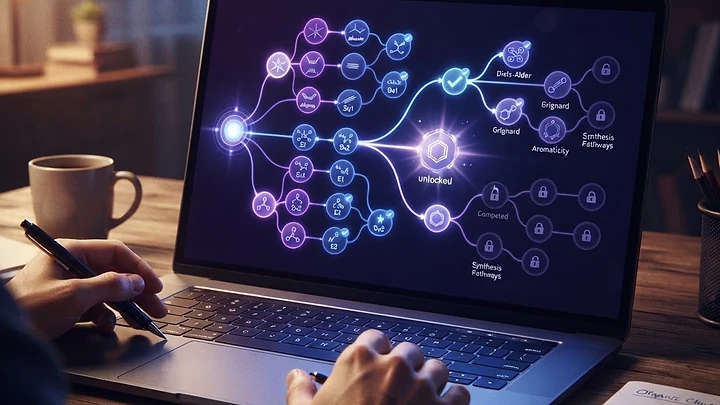
The AI professor uses visual aids to map out electron movement, helping you move from blind memorization to a true conceptual understanding of reaction mechanisms.
Direct answer
You can master organic chemistry mechanisms by using the AI Organic Chemistry Professor. Taught by a sophisticated AI, the course utilizes AI-Adaptive Learning to identify your specific gaps and tailor lessons to your needs. It is available 24/7 for consistent support, helping you succeed for only $5/month.
How does an AI professor teach organic chemistry mechanisms differently?
An AI professor simplifies complex reactions by focusing on electronic flow rather than memorization, allowing you to visualize movement through an interactive, digital medium. Unlike a static textbook that presents every mechanism with the same level of detail, the AI adjusts the pacing based on your grasp of core foundational concepts like electronegativity and resonance.
Traditional learning often forces students to memorize hundreds of individual reactions without understanding the underlying logic. This leads to "the organic wall," where students struggle because they lack a deep understanding of electron movement, such as nucleophilic attacks or leaving group departures. The AI professor breaks these down into universal patterns. By understanding how electrons move from a high-electron density area to a low-electron density area, you begin to predict the products of a reaction before you even see them.
Consider the nucleophilic substitution reaction, specifically the SN2 pathway. Instead of forcing you to memorize the specific reagents and conditions, the AI professor shows you the transition state step-by-step. It asks you to predict where the nucleophile will approach, why the inversion of configuration occurs, and how steric hindrance influences the rate. This is not about passive reading; it is about active engagement.
If you struggle with the concept, the AI does not just repeat the same explanation; it presents a new perspective or a related exercise that bridges the gap in your current understanding.
The core benefits of this approach include:
- Improved conceptual retention through iterative testing
- Instant feedback on electron-pushing diagrams
- Personalized pacing that speeds up on known topics and slows down on difficult ones
- Immediate availability for study sessions late at night or early in the morning
By framing the subject through the lens of movement and logic, the course transforms Organic Chemistry from a memorization chore into an intuitive science. You learn to recognize the "Why" behind the "What," which provides the flexibility needed for exams where you encounter reactions you have never seen before. The AI acts as a patient tutor that never grows tired of explaining the same concept from five different angles until you achieve total clarity.
Can I really learn complex reaction pathways through a subscription service?
Yes, because the subscription model provides the consistency required for long-term retention of difficult scientific principles. By integrating regular, bite-sized study sessions into your daily routine, you avoid the common pitfall of cramming, which rarely leads to a deep understanding of complex chemistry concepts.
Consistent practice is the cornerstone of organic chemistry success. Because the material is delivered via an AI platform, you are essentially getting a private tutor that tracks your progress every single day. If you find that your understanding of functional groups is solid, the system recognizes this and advances you to more challenging topics like carbonyl chemistry or multi-step synthesis. If you are struggling with something fundamental, such as acid-base reactions, the system identifies that gap and automatically cycles back to reinforce that knowledge before moving forward.
Let us look at a practical example: carboxylic acid derivatives. A student might try to memorize the reactivity order of acid chlorides, anhydrides, esters, and amides through brute force. However, the AI approach shows how the resonance stabilization of the carbonyl carbon changes depending on the attached group. By visualizing these molecules, you quickly realize why amides are the least reactive and acid chlorides are the most reactive.
Once you understand the resonance factor, the entire table of reactivity becomes intuitive. You no longer have to memorize it; you can derive it on the spot.
Essential components of the learning framework:
- Scaffolded complexity where topics build linearly on previous mastery
- Dynamic problem generation to ensure you never memorize answers to specific questions
- Real-time diagnostic reporting to show you exactly where your knowledge is lacking
- The ability to toggle between summary views and deep-dive technical explanations
This method allows you to cultivate an organic chemistry intuition. When you face an exam, you are not trying to recall a specific page in a textbook; you are relying on the framework of electron movement that you have practiced through hundreds of iterations. The subscription ensures that this service is always there, meaning your learning process is continuous rather than sporadic.
How does AI-Adaptive Learning identify and fill my knowledge gaps?
AI-Adaptive Learning works by mapping your responses against a sophisticated knowledge graph of the entire organic chemistry curriculum to detect the exact point where your understanding falters. It then adjusts the curriculum in real-time, ensuring you receive instruction that is neither too easy nor frustratingly difficult, but perfectly calibrated for your current stage.
Traditional classroom settings use a one-size-fits-all approach, where a professor teaches to the middle of the class. If you are faster, you get bored; if you are slower, you fall behind. The AI professor, however, creates a unique learning path for every single student. If you excel at nomenclature but struggle with stereochemistry, the AI will automatically reduce the frequency of nomenclature exercises and increase the depth of stereochemical instruction.
When you engage with a problem, the AI analyzes more than just whether your final answer is correct or incorrect. It examines the process. If you correctly identify the major product but use the wrong intermediate, the AI detects that flaw in your reasoning and triggers a targeted lesson on that specific part of the mechanism. This is akin to a professor watching you write a mechanism on a whiteboard and stepping in exactly when you make an electron-pushing error to correct your logic before you finish the entire problem.
The adaptive process functions through:
- Baseline assessments to determine your starting proficiency level
- Continuous monitoring of error patterns to identify conceptual weaknesses
- Automatic rescheduling of difficult topics to improve long-term memory
- Contextual hints that guide you toward the solution without providing it outright
This level of personalization is effectively impossible in a physical classroom. By constantly updating its model of your knowledge, the AI ensures that your study time is used as efficiently as possible. You stop wasting hours reviewing what you already know, and you spend your limited time mastering the specific areas that actually present a challenge for your current skill level.
Is it worth paying for an AI organic chemistry course vs alternatives?
When comparing the cost of an AI organic chemistry course to traditional alternatives like private tutors or university-based learning centers, the value proposition is clear: you are gaining 24/7 access to high-quality instruction for a fraction of the cost. Most students find that the ability to get immediate, personalized help at any hour is worth far more than the nominal $5 monthly fee.
Think about the accessibility gap. A private tutor might cost fifty or one hundred dollars per hour, and they are usually only available for scheduled sessions during normal business hours. If you are working on a problem at 2:00 AM, you are on your own. With an AI professor, the "tutor" is always available. The cost-efficiency allows you to maintain consistent, daily study habits without the barrier of high financial commitments or travel time. You pay once for the month and have unlimited access to every single module, drill, and assessment tool offered in the course.
Furthermore, the quality of instruction in an AI course is consistent. A human tutor might have a "bad day," or they might be excellent at one aspect of chemistry but struggle to explain another. The AI has been trained on the entire scope of the curriculum and provides a standardized, high-quality experience every single time. It does not get tired, it does not get impatient, and it does not judge you if you get the same question wrong ten times in a row.
Key factors that drive value:
- Zero commute time means you can integrate study into your existing schedule
- Unlimited attempts at practice problems ensure deep familiarity with mechanics
- Comprehensive coverage of all essential organic chemistry topics
- The absence of hidden costs, scheduling fees, or travel expenses
Investing in your education using this modern approach allows you to shift your budget toward resources that actually work. Because you are not paying for the overhead associated with traditional tutoring, the price stays low and the quality of the personalized guidance remains consistently high. It is a smarter, more scalable way to learn a subject that often acts as a gatekeeper for professional programs.

By the numbers
The picture at a glance.
Why Students Choose AI-Adaptive Learning
This chart illustrates the key advantages of choosing an AI-driven learning approach for organic chemistry.
Study Method Comparison
A breakdown of why students are moving away from traditional study methods.
Side by side
How the options compare.
Comparing Methods of Learning Chemistry
| Study Method | Availability | Cost | Adaptive Learning |
|---|---|---|---|
| AI Professor | 24/7 | $5/month | Yes |
| Private Tutor | Limited | $50+/hr | No |
| Textbook Study | 24/7 | One-time | No |
| Group Tutoring | Scheduled | Varies | No |
Study Success Factors
| Study Habit | Effectiveness | Effort Level |
|---|---|---|
| Consistent AI Practice | High | Low |
| Last-Minute Cramming | Low | High |
| Passive Lecture Attendance | Medium | Medium |
| Active Mechanism Drawing | High | High |
The data
What the numbers look like.
Average Monthly Cost Comparison
This chart shows how much you save by choosing an AI subscription over traditional alternatives.
USD per month
Retention Rates Over Time
Students using adaptive learning show better long-term retention compared to traditional passive study.
Percentage of concepts retained
Enrol
Start today.
AI Organic Chemistry Professor is taught by an AI professor that adapts to what you already know, available 24/7, from $5/month.