Special Interest Courses · AI Wine & Cheese Professor
How Do I Learn to Pair Wine and Cheese Like a Sommelier?
This guide explores the fundamentals of artisan cheese and wine pairing, explaining how you can master complex flavor profiles and structural balances through an accessible, high-tech learning approach.
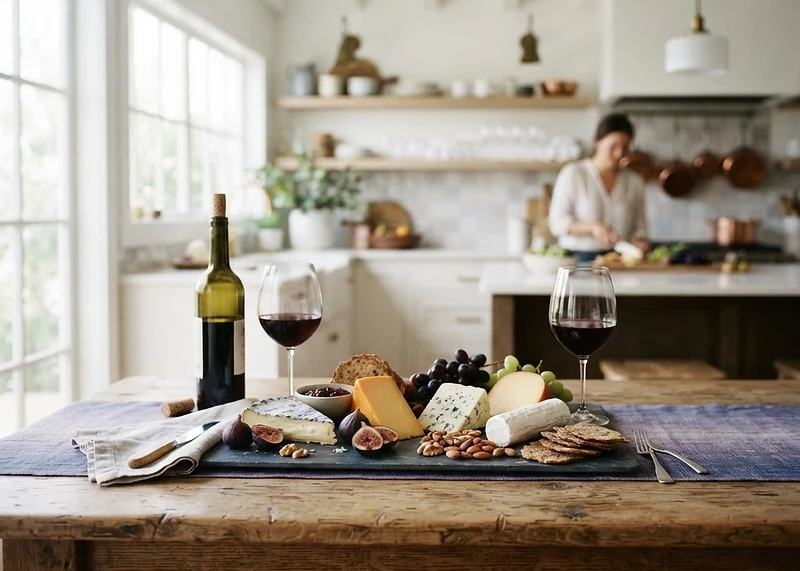
A well-organized pairing board demonstrates how diverse textures and flavors interact, serving as the practical goal for every student in the course.
Direct answer
You can master the art of pairing wine and cheese through the AI Wine & Cheese Professor course. Taught by an AI professor, this program utilizes AI-Adaptive Learning to tailor content to your specific palate and knowledge level. It is available 24/7 for only $5/month, providing expert-level guidance whenever you are ready.
Why do certain wine and cheese pairings work better than others?
Pairing works because of the interplay between fat, acidity, tannins, and salt. When you understand these structural components, you stop guessing and start creating intentional, delicious combinations.
At its core, pairing is about balance. Cheese is often rich in fat and protein, while wine provides acidity, tannins, or sweetness to cut through that richness. If you pair a very delicate cheese with an overpowering wine, the flavor of the cheese disappears entirely. Conversely, a wine with low acidity can taste flat when served alongside a sharp, aged cheddar. The AI Wine & Cheese Professor breaks down these interactions into a learnable system.
Consider the concept of bridge ingredients. These are foods or flavors that connect the wine and the cheese. For example, a dollop of fig jam acts as a bridge between a goat cheese and a Sauvignon Blanc, as the fruit notes complement the acidity of both the wine and the cheese. Learning these techniques allows you to compose boards that feel sophisticated and well-planned.
- Acidity cuts through the fat of creamy cheeses like Brie.
- Tannins in red wine can clash with blue cheese, causing a metallic sensation.
- Salt in aged cheeses enhances the fruitiness of many white wines.
- Texture matching ensures the wine is not overwhelmed by the density of the cheese.
Beyond basic mechanics, there is the historical context of regionality. Wines from a specific region are often paired with cheeses from that same area because they evolved together over centuries. This is why French Sancerre pairs beautifully with regional goat cheeses. Understanding this "what grows together, goes together" philosophy simplifies your decision-making process when shopping for a gathering.
By learning these rules, you move from simple consumption to true appreciation, allowing you to identify what makes a pairing harmonious rather than just guessing. This analytical framework forms the foundation of our course, helping you develop a sommelier-level intuition for flavor dynamics that you can apply to any dinner party or personal tasting experience you host in the future.
How does an AI professor teach wine and cheese pairing differently?
An AI professor adapts to your personal palate and speed, offering a custom curriculum that evolves as you demonstrate mastery over different flavor profiles. Unlike a static textbook, the AI tracks your progress and reinforces the areas where you need more practice.
Standard wine education often involves long, boring lectures that assume every student has the same baseline knowledge. Our AI-Adaptive Learning technology changes this dynamic. If you already understand the basics of acidity but struggle with tannin structures, the system adjusts to focus more on red wine variations and aged hard cheeses. This ensures your learning time is spent effectively, addressing your unique gaps in knowledge rather than reviewing information you have already internalized.
Furthermore, the system provides instant feedback during interactive modules. If you are asked to select a wine for a specific Stilton and you choose the wrong varietal, the system does not just mark it as incorrect. It explains the molecular reason why that specific pairing fails, such as the way the blue mold reacts with the tannins in an oak-aged Cabernet. This allows for deep learning that mimics a mentorship experience.
- Instant error correction helps you refine your palate faster.
- Curated tasting lists ensure you are practicing with widely available wines.
- Personalized quizzes highlight your weak spots in regional knowledge.
- Continuous updates integrate the latest trends in global wine and cheese production.
The AI also keeps your learning schedule flexible. Whether you have ten minutes during a lunch break or two hours on a Sunday afternoon, the course material adjusts to fit the time you have available. By focusing on high-impact learning cycles rather than traditional long-form instruction, you gain the ability to analyze and pair wines with confidence without needing to dedicate weeks to formal study. This efficient, data-driven approach is designed to produce results for busy professionals who want to develop a deep, practical hobby that adds value to their social and professional life.
What are the foundational skills every beginner needs to master?
Beginners must focus on identifying the five key structural elements of food and wine: fat, salt, acidity, sweetness, and tannin. Once these are understood, you can systematically categorize any cheese or wine you encounter to predict how it will perform in a pairing.
Start by isolating these factors in isolation. Taste a piece of Pecorino and note the high salt content; compare it to the creamy, fatty texture of a Triple Cream Brie. When you learn to separate these sensations, you stop seeing food and wine as a mystery and start seeing them as a set of chemical variables. This is the first step toward building a repertoire of reliable pairings that you can repeat with confidence.
Next, learn the impact of aging and oxidation. An aged Gouda, which has developed tyrosine crystals for crunch and a butterscotch flavor profile, requires a completely different wine companion than a fresh, mild mozzarella. The aging process transforms the cheese's internal chemistry, changing its requirement for acid or fruit character in the wine. Similarly, a wine that has been aged in oak will offer vanilla and spice notes that a stainless-steel fermented wine will lack, creating different opportunities for pairing with nutty or washed-rind cheeses.
- Develop your vocabulary to describe flavor profiles accurately.
- Practice comparing similar wines to distinguish between subtle acidity levels.
- Keep a tasting journal to document what works and what does not.
- Experiment with contrast versus complementary pairing strategies.
Building this base requires exposure to a variety of styles, but it does not have to be expensive. You do not need to buy rare bottles to learn these principles. The course guides you through selecting affordable, representative examples of major wine styles and cheese categories, teaching you how to evaluate them effectively. By focusing on these core pillars, you establish a permanent framework for understanding flavor that will stay with you long after the course concludes.
This structured approach removes the intimidation factor that often keeps people away from deeper exploration, providing a clear path from beginner to enthusiast.
How can I maintain my learning progress on a budget?
Maintaining your progress is about consistent, low-cost application rather than expensive buying sprees. By focusing on small, focused tasting flights, you can maximize your sensory education for the price of a few bottles of wine and a bit of cheese.
Consistency is far more important than quantity. You learn more by tasting two different white wines with the same goat cheese side-by-side than you do by drinking an expensive bottle alone. This comparative tasting technique is the secret to rapid development. Because our course is only $5/month, you can allocate your remaining budget toward building a "classroom" of diverse samples. We guide you on exactly which types of wines and cheeses to buy to maximize your learning outcomes without breaking the bank.
We also encourage community-based learning where you can share your findings and results with others. By engaging with other students, you get to see how different people perceive the same pairing. One person might find a pairing overly acidic, while another finds it refreshing, helping you understand that palate perception is subjective. This peer interaction, facilitated by our platform, adds a layer of depth that solo study often lacks.
- Host small tasting sessions to rotate the costs among friends.
- Focus on domestic producers that offer better value than imported labels.
- Use the AI tool to plan your shopping list based on current local availability.
- Rotate your focus each month between different regions or styles.
The convenience of having an AI professor available 24/7 means you are never stuck waiting for a scheduled class. If you are at the store on a Friday night and wondering if a certain blend will work with an Alpine-style cheese, you can query the system and get an immediate recommendation based on the principles you have already learned. This on-demand access is the ultimate tool for practical, real-world skill building. By integrating this practice into your regular shopping and dining habits, you turn every grocery trip into a learning opportunity, ensuring that your skills grow continuously over time without requiring huge blocks of dedicated study or large financial investments.


By the numbers
The picture at a glance.
Cost Efficiency Comparison
The monthly investment required for specialized knowledge is significantly lower when utilizing digital AI-based instruction.
Learning Accessibility
Digital platforms offer superior flexibility, allowing students to integrate education into their busy lives seamlessly.
Side by side
How the options compare.
Pairing Methodology Comparison
| Feature | AI Professor | Textbook | Live Tutor |
|---|---|---|---|
| Adaptive Content | Yes | No | Partial |
| Availability | 24/7 | Fixed | By Appointment |
| Feedback Loop | Instant | Delayed | Contextual |
| Monthly Cost | $5 | Varied | $400+ |
Skill Development Milestones
| Phase | Focus | Outcome |
|---|---|---|
| Beginner | Palate Basics | Flavor Identification |
| Intermediate | Structural Rules | Intentional Pairing |
| Advanced | Regional Nuance | Sommelier Intuition |
The data
What the numbers look like.
Estimated Time to Master Pairing Fundamentals
Students utilizing AI-adaptive learning reach competency faster due to personalized, focused study paths.
Hours per week
Information Retention Rates
Interactive and adaptive systems improve memory recall compared to static learning formats.
Retention Percent
Enrol
Start today.
AI Wine & Cheese Professor is taught by an AI professor that adapts to what you already know, available 24/7, from $5/month.