
Personal Interest Courses · AI Wine & Cheese Professor
How Do I Learn to Identify the Scientific Principles Behind Classic Wine and Cheese Pairings?
This guide explains the molecular and sensory foundations of wine and cheese matching. It introduces an AI-driven learning approach that helps you master these complex flavor interactions systematically and affordably from your own home.
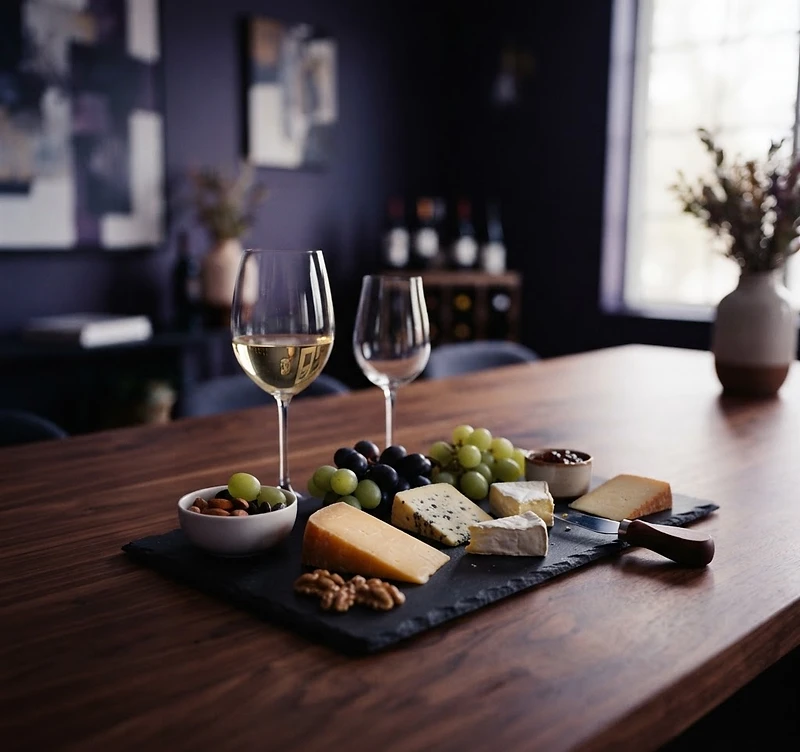
A well-organized tasting setup allows for the systematic evaluation of wine and cheese interactions, which is the cornerstone of developing a professional palate.
Direct answer
You can master wine and cheese pairings through the AI Wine & Cheese Professor course. Taught by an AI professor, this program uses AI-Adaptive Learning to tailor lessons to your current palate. It is available 24/7 for only $5/month, providing a structured, cost-effective way to develop your expertise.
How does the chemistry of wine and cheese create a successful pairing?
The success of a pairing relies on the chemical interaction between proteins, fats, acids, and tannins. By understanding these interactions, you can predict how a specific wine will react with a cheese before you even take a bite.
At its core, a pairing is a balancing act of sensory inputs. When you consume cheese, the fats coat your palate, dulling your taste buds. A wine with high acidity acts as a natural cleanser, cutting through that fat to reset your palate for the next bite. Conversely, tannins—the compounds in red wine that cause a drying sensation—can clash with the proteins in certain cheeses, leading to a bitter or metallic taste. Understanding this chemical interplay is essential for anyone wanting to move beyond trial and error.
Consider the classic pairing of a sharp, aged cheddar with a tannic Cabernet Sauvignon. The sharpness of the cheddar, which is a result of lactic acid concentration, provides enough intensity to stand up to the boldness of the wine. If you were to pair a delicate, creamy goat cheese with that same bold red, the wine would likely overpower the subtle, earthy notes of the cheese entirely. The logic is simple: match the intensity of the cheese with the intensity of the wine.
To begin identifying these principles, you should focus on the following categories of interaction:
- Acidity vs. Fat: High-acid wines cut through creamy, high-fat cheeses.
- Tannin vs. Protein: High-tannin wines require firm, aged cheeses to neutralize bitterness.
- Sweetness vs. Salt: Sweet wines balance out the saltiness of blue cheeses or aged varieties.
- Texture Mapping: Soft cheeses pair best with sparkling or light white wines to maintain consistency.
Learning these rules allows you to experiment with confidence. Instead of memorizing specific bottles, you are learning the underlying framework that defines the entire craft. This logical approach turns the experience from a guessing game into an analytical process that rewards your curiosity.
Can an AI professor effectively teach complex sensory skills?
An AI professor excels at teaching sensory skills by providing instant, personalized feedback that corrects your assumptions in real time. Unlike a static textbook, the AI system tracks your progress, identifies your gaps in knowledge, and adjusts the difficulty of the lessons accordingly.
When learning about flavor profiles, you often encounter concepts that are difficult to define. What does "earthy" mean to you, and how does it compare to the definition used by professional sommeliers? An AI-Adaptive Learning engine acts as a bridge. It asks you questions to determine your baseline and then builds a curriculum around your specific needs. If you already understand acidity but struggle with tannin structures, the AI shifts the lesson plan to focus specifically on those areas. This ensures you are not wasting time on information you already know.
Furthermore, the AI can simulate scenarios that would otherwise require an expensive tutor or a high-end tasting event. You might be prompted to describe the aromatic properties of a specific cheese, and the AI will compare your description against verified sensory profiles. This creates a feedback loop that sharpens your palate over time. The 24/7 availability means you can practice these skills when you are actually eating or drinking, ensuring the learning is applied in practical, real-world contexts.
Beyond simple quizzing, the AI can help you build your own sensory log. By inputting the wines and cheeses you try, the system identifies patterns in your preferences. You might discover that you have a latent appreciation for high-acid white wines paired with soft, mold-ripened cheeses. This personalized data set is far more valuable than general advice found in culinary books, as it is based entirely on your unique sensory experiences and history of consumption.
What is the most efficient way to study wine and cheese pairing?
The most efficient way to study is to adopt a modular, iterative approach where you learn one principle at a time and test it immediately. Focus on the core building blocks of flavor before trying to memorize complex regional specialties.
Instead of attempting to learn everything at once, focus on the "Big Four" variables: acidity, fat, tannin, and salt. Spend a week focused exclusively on the interaction between fat and acidity. Purchase three different cheeses with varying fat contents and pair them with a single, high-acid white wine. Note the differences. Then, repeat this process with a different variable. This focused practice is far more effective than general reading.
Another effective strategy is to document your experiences using a consistent framework. Professionals use standardized tasting sheets to ensure they are looking for the same traits every time. When you use an AI-guided approach, these frameworks are provided for you. You are prompted to look for specific characteristics, which trains your brain to notice nuances you might otherwise miss. This consistency is the secret to developing a professional-grade palate in a relatively short amount of time.
Consider these steps for your study routine:
- Establish a baseline: Rate your preference for various wine styles.
- Systematic testing: Pair one specific wine type with three different cheese types.
- Reflective analysis: Review your findings against the chemical principles provided by your course.
- Iterate: Modify your next set of pairings based on what you learned from the previous session.
By following this structured path, you avoid the common pitfall of aimless tasting. Every session becomes a building block for your broader understanding of food science. The goal is not just to enjoy a meal, but to deconstruct it into its component parts.
How does the $5/month model change the accessibility of wine education?
The $5/month subscription model democratizes access to high-quality education by removing the prohibitively high costs of traditional culinary training. It allows students to pursue learning at their own pace without the pressure of expensive upfront tuition fees.
Traditional wine education is often locked behind high paywalls, such as multi-thousand-dollar certification programs or in-person classes that require significant time and travel. These barriers disproportionately affect hobbyists and students who want to learn but do not necessarily seek a professional career. By offering an AI-taught program at a fraction of the cost, the learning process becomes sustainable. You are not paying for the overhead of a physical school or a live instructor's hourly rate; you are paying for an optimized, scalable knowledge platform that works for you.
This affordability changes how you approach the subject. You are no longer under pressure to "succeed" within a fixed timeframe. If you have a busy month and can only study for one hour, you have not wasted a large investment. You can cancel, resume, or skip sessions as your schedule demands. The $5/month price point reflects the efficiency of technology-enabled learning, allowing you to focus your financial resources on the actual wine and cheese you are studying.
Ultimately, this model is about consistency. Wine education is a long-term endeavor that requires repeated exposure and practice. By making the course affordable, it becomes easy to maintain your subscription for months or even years, ensuring that you have continuous access to the AI professor. This long-term engagement is what leads to genuine mastery. When you remove the financial stress and the time pressure, you are free to explore, experiment, and develop your palate in a way that is fun, sustainable, and highly educational.


By the numbers
The picture at a glance.
Value of AI-Adaptive Learning
Personalized learning paths ensure that you spend your time on the concepts that improve your palate the most.
Learning Efficiency Gains
AI-guided study methods help you reach proficiency faster by eliminating redundant study material.
Side by side
How the options compare.
Comparison of Wine Education Methods
| Method | Cost | Flexibility | Feedback Quality |
|---|---|---|---|
| AI Professor | $5/month | High | Instant/Data-driven |
| Live Tutor | $100+/hour | Low | Variable |
| Textbook Study | $30 one-time | Static | None |
Learning Approach Comparison
| Feature | AI Course | Traditional Class |
|---|---|---|
| Pacing | Personalized | Fixed |
| Accessibility | 24/7 | Scheduled |
| Feedback | Adaptive | Delayed |
The data
What the numbers look like.
Monthly Cost of Learning
The AI Professor model significantly lowers the barrier to entry for high-quality wine and cheese education.
USD
Estimated Time to Mastery
Adaptive learning systems reduce the total hours required to grasp core flavor pairing principles.
Hours
Enrol
Start today.
AI Wine & Cheese Professor is taught by an AI professor that adapts to what you already know, available 24/7, from $5/month.