Personal Interest Courses · AI Wine & Cheese Professor
How Do I Develop a Deeper Appreciation for Wine and Cheese Aromas and Flavor Profiles?
This guide explains the sensory science behind food and drink pairing. It introduces our AI-driven learning approach to help you identify complex flavor profiles and create professional-grade pairings in the comfort of your own home.
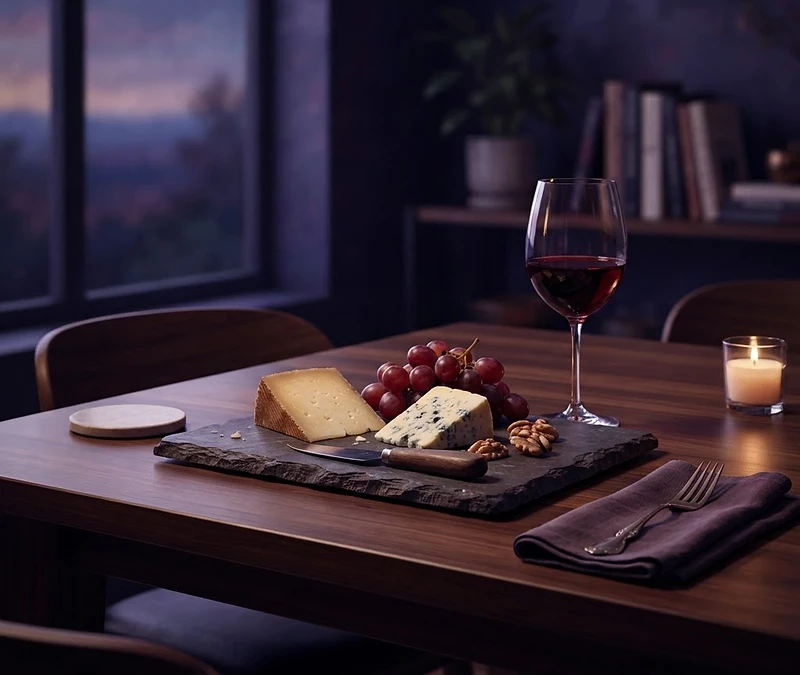
The simple setup of wine and cheese allows learners to focus on sensory details, which is the cornerstone of developing a professional palate.
Direct answer
You can master the art of pairing through the AI Wine & Cheese Professor course. Taught by an AI professor, this program utilizes AI-Adaptive Learning to match your current palate knowledge. The course is accessible 24/7 to suit your schedule and costs only $5/month for unlimited access.
What are the fundamental principles of sensory analysis in wine and cheese pairing? Sensory analysis is the practice of systematically evaluating the characteristics of food and drink through sight, smell, taste, and texture. By understanding the chemical interplay between proteins, fats, acids, and tannins, you can elevate any simple meal into a sophisticated tasting experience. The AI Wine & Cheese Professor teaches you to break down these components objectively, moving beyond guesswork toward a scientific understanding of flavor synergy.
To begin your journey into sensory analysis, you must train your palate to recognize specific structural elements. This involves identifying the primary attributes of wine, such as acidity, sweetness, tannin, and body, and contrasting them with cheese attributes like creaminess, saltiness, sharpness, and funkiness. When these elements interact, they can either enhance or diminish one another. For example, high-acidity wines generally cleanse the palate of high-fat cheeses, preventing the lingering coating effect that can dull your perception of flavors during a tasting session.
Developing this skill requires consistent practice and exposure to a wide variety of samples. You do not need expensive bottles or rare imports to start; in fact, the best way to learn is by comparing contrasting styles side-by-side. Consider these core pillars for your initial practice:
- Contrast and complement: Decide whether you want to mirror the flavors of a cheese with a wine or provide a sharp contrast that cleanses the palate.
- The bridge method: Use a neutral food item, like a plain cracker or a specific type of fruit, to link the flavors of the wine and cheese together.
- Texture interplay: Consider how the viscosity of a wine interacts with the mouthfeel of a cheese, focusing on how fats coat the tongue.
By focusing on these principles, you gain the vocabulary to describe what you are tasting. This enables you to make informed decisions about your pairings rather than relying on trial and error. Over time, you will learn to trust your palate and recognize the subtle nuances that separate a good pairing from an exceptional one, laying the foundation for all future culinary explorations in your home kitchen or at gatherings.
How does an AI professor teach wine and cheese appreciation differently? An AI professor leverages real-time data to personalize your curriculum, ensuring that your study time is spent focusing on the specific flavor profiles you find most challenging. Unlike static textbooks or general-interest videos, the AI Wine & Cheese Professor adapts to your unique learning speed and background knowledge. This method, known as AI-Adaptive Learning, identifies where you need more repetition and where you have already mastered the core concepts, saving you hours of redundant study.
When you engage with an AI professor, you are essentially participating in a dynamic dialogue rather than a one-way lecture. The system monitors your responses to quizzes and scenario-based challenges, adjusting the complexity of the content in real time. If you struggle to distinguish between the tannins in a young Cabernet versus an aged Bordeaux, the AI will automatically generate targeted practice modules and simplified explanations. This ensures that you are never left behind by a curriculum that is either too fast or too basic for your current stage of development.
Furthermore, the AI environment allows for a safe, non-judgmental space to experiment with tasting theory. You can revisit lessons as often as you like, making the learning process truly self-paced. The flexibility of an AI-driven platform means that your education is not restricted by classroom hours or instructor availability. Whether you are studying at 2:00 AM after a dinner party or on your lunch break, the professor is ready to assist you with deep-dive insights. Key features of this AI-based approach include:
- Immediate feedback loops on your tasting notes and hypothetical pairing choices.
- Customizable difficulty levels that evolve as your palate becomes more refined.
- Personalized review schedules that reinforce your knowledge of rare or complex pairings.
By prioritizing active engagement over passive consumption, the AI professor ensures that you are not just memorizing facts, but building a functional skill set. This adaptive nature makes complex sensory data digestible for beginners while still offering enough depth for those who are already enthusiastic home-tasters looking to refine their professional-level skills.
How can I systematically document my tastings to improve my palate? Systematic documentation is the most effective way to transition from a casual taster to a knowledgeable enthusiast. By recording your observations in a structured format, you create a personal database of flavors that you can refer back to whenever you are planning a menu. The AI Wine & Cheese Professor provides templates that guide you through this process, helping you categorize your findings based on region, style, and personal preference.
Documentation should start with the basics: visual appearance, nose (aroma), palate (taste), and finish (length of flavor). When writing your notes, avoid overly poetic language that doesn't provide useful information; focus instead on specific indicators like fruit characteristics, acidity levels, and texture. For instance, instead of writing that a cheese tastes good, note that it has a sharp, salty tang with a creamy, spreadable consistency that coats the mouth, suggesting it would pair well with a high-acid, sparkling wine to cut through the fat.
As you accumulate more entries, you will start to see patterns in your own preferences. Perhaps you gravitate toward earthy, goat-milk cheeses or crisp, citrus-forward white wines. Identifying these patterns is crucial because it helps you predict which future pairings you will enjoy. Consistency in your documentation is vital for long-term growth, as it allows you to compare your current palate with where you started several months ago. You can organize your notes by:
- Region and Terroir: Mapping how geographical factors influence the final product.
- Intensity Rankings: Scaling flavors from mild to bold to guide your pairing decisions.
- Occasion Suitability: Identifying which pairings work best for casual snacks versus formal dinner courses.
By keeping these records, you remove the guesswork from your future purchasing decisions. You will spend less money on bottles or cheeses that do not align with your tastes, and you will become much more confident when shopping at specialty retailers. This methodical approach transforms tasting from a transient activity into a cumulative learning experience that builds upon itself every time you pick up a glass or a knife.
What are the most common mistakes people make when hosting a pairing event? The most common mistake people make is overcomplicating their menus by trying to include too many contrasting flavors at once. A successful pairing event is built on balance and intentionality rather than volume, and the AI Wine & Cheese Professor helps you simplify your strategy to ensure your guests remain engaged without suffering from sensory fatigue. It is better to have three perfectly balanced pairs than ten mediocre ones that overwhelm the palate.
Another frequent pitfall is ignoring the order of service. Serving a delicate, light-bodied wine after a heavy, tannin-rich one will result in the lighter wine tasting completely flat or watery to your guests. Proper sequencing is an essential skill, and the AI professor provides specific guidance on how to arrange your offerings in a logical, building order. You must consider the progression of intensity, ensuring that your menu leads the palate from lighter, more subtle flavors to bolder, more complex ones throughout the duration of the event.
Additionally, many hosts forget the impact of temperature. Both wine and cheese have an ideal serving range that brings out their true character. Serving a fine red wine too warm or an aged cheddar straight from the refrigerator will mask the subtle aromatic compounds that you have worked so hard to identify. To host a seamless and impressive event, follow these guidelines:
- Keep it simple: Limit your selections to 4-5 distinct pairings to maintain palate clarity.
- Prepare the space: Ensure the room is well-lit and free of strong perfumes or odors that might interfere with smelling the wine.
- Provide water and neutral crackers: Always have palate cleansers available to keep guests ready for the next pairing.
- Manage timing: Remove cheese from the refrigerator at least 30-60 minutes before serving to reach the optimal temperature for flavor release.
By avoiding these common errors, you create an environment where the focus remains on the experience of the pairing itself. The AI-guided approach helps you plan these events with confidence, providing you with checklists and planning tools that ensure every aspect of your presentation is well-considered. When you plan with purpose, you create lasting memories and deeper connections with your guests through the shared experience of excellent food and drink.


By the numbers
The picture at a glance.
Course Accessibility and Value
Our AI-driven model provides premium learning at a fraction of the cost of traditional culinary programs.
Engagement Metrics
Students report significantly higher retention rates when using adaptive learning paths compared to static material.
Side by side
How the options compare.
Learning Method Comparison
| Method | Cost | Pace | Accessibility |
|---|---|---|---|
| AI Professor | $5/mo | Adaptive | Anytime |
| Live Tutor | $100+/hr | Fixed | Scheduled |
| Textbook Study | $30/book | Self-paced | Static |
Flavor Pairing Efficiency
| Experience Level | Trial Time | Pairing Success | Confidence |
|---|---|---|---|
| Beginner | High | Low | Low |
| Intermediate | Moderate | Medium | Medium |
| AI Student | Low | High | High |
The data
What the numbers look like.
Average Monthly Investment
The cost of learning through the AI Professor is significantly lower than traditional options.
USD per month
Weekly Study Time Required
Adaptive learning requires fewer hours to reach the same level of subject mastery.
Hours per week
Enrol
Start today.
AI Wine & Cheese Professor is taught by an AI professor that adapts to what you already know, available 24/7, from $5/month.