Personal Interest Courses · AI Wine & Cheese Professor
How Do I Build a Wine and Cheese Pairing Foundation on a Budget?
Building a sophisticated palate for wine and cheese pairings does not require expensive formal education. This guide explores how AI-adaptive learning provides a personalized, accessible path to mastering classic combinations from the comfort of your own home.
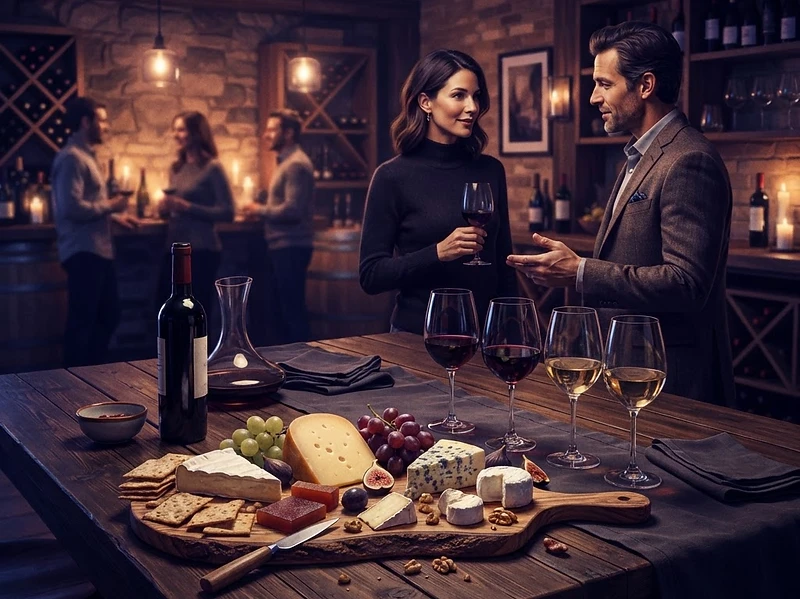
A well-curated tasting setup illustrates the practical goal of the course: transforming everyday moments into professional-level culinary experiences.
Direct answer
You can master wine and cheese pairing fundamentals through the AI Wine & Cheese Professor course. Taught by an AI professor using AI-Adaptive Learning, the curriculum evolves based on your existing knowledge. This 24/7 accessible platform offers a structured, professional-grade education for a subscription price of only $5/month.
How does AI-adaptive learning improve the study of wine and cheese pairings?
AI-adaptive learning improves wine education by dynamically adjusting the depth and technicality of content based on your specific responses and identified knowledge gaps. Unlike static textbooks or general-purpose blogs, an AI professor detects which regions, flavor profiles, or aging processes you already understand and which you need to revisit.
Traditional learning often treats every student as a blank slate, forcing experts to sit through beginner material while beginners feel overwhelmed by advanced terminology. The AI system acts as a personalized tutor, evaluating your ability to distinguish between acidity, tannins, fat content, and salinity. When you correctly identify why a high-tannin Cabernet Sauvignon clashes with a delicate goat cheese, the system advances to more complex pairing variables. Conversely, if you struggle with basic concepts like how fat coats the palate to balance wine acids, the AI provides targeted, contextual examples to bridge that specific gap.
This method allows for a customized learning path that prioritizes your growth over a predetermined schedule. You are not forced to follow a linear path of lectures. Instead, you interact with curated modules that challenge your current level of expertise. This creates a more engaging experience because the content feels relevant and appropriately challenging. You retain more information because you are actively applying logic to new scenarios rather than passively reading through chapters.
Consider the practical application of this system in your study sessions:
- Diagnostic assessments establish your baseline knowledge of grape varietals and cheese classifications.
- Scenario-based challenges ask you to select pairings for hypothetical events, providing immediate feedback on your choices.
- Adaptive quizzes repeat difficult concepts in different contexts to ensure long-term mastery.
- Progress tracking dashboards visualize which areas of pairing science you have mastered and which need further exploration.
By leveraging an AI instructor, you gain a partner that remembers your past mistakes and successes, ensuring that future lessons build upon a rock-solid foundation rather than repeating basic information you have already internalized.
Which core principles must you master to create successful wine and cheese pairings?
Successful pairing relies on the interplay of structural components like acidity, sweetness, salinity, and fat rather than arbitrary rules. The foundational principle is to match intensity and bridge flavors, ensuring neither the food nor the drink dominates the experience. You must understand how to balance the biological responses of your taste buds to specific flavor profiles.
For instance, the acidity in a crisp Sauvignon Blanc acts as a palate cleanser, cutting through the rich, creamy texture of a triple-crème brie. If you paired a delicate, low-acid wine with that same cheese, the wine might taste flat or flabby. Similarly, a salty blue cheese, such as Roquefort, thrives when paired with a sweet dessert wine like Sauternes. The saltiness of the cheese contrasts with the sugar in the wine, creating a harmonious balance that makes both items taste significantly better than they would individually. These interactions are governed by chemistry, not subjective opinion.
Beyond basic contrasts, you should learn the concept of regional synergy. Wines produced in a specific geographic area often evolved alongside the local cheeses produced there. For example, the wines of the Loire Valley are a natural match for goat cheeses produced in the same terroir. By studying the history and environmental conditions of these regions, you learn to trust historical tradition as a guide for your modern pairings. This is a framework you can use at any grocery store or specialty shop.
To master these principles, focus on these essential pairing pillars:
- Intensity Alignment: Ensure the body of the wine matches the weight of the cheese.
- Acid-Fat Balance: Use high-acidity wines to slice through heavy, fatty cheeses.
- Sweetness Offsetting: Pair salty foods with sweet wines to highlight complex flavors.
- Tannin Management: Avoid high-tannin wines with creamy cheeses as they can leave a metallic sensation.
When you understand these pillars, you move away from memorizing lists and toward a logical, analytical approach to pairing that works in any situation, whether you are hosting a formal dinner or putting together a quick snack for yourself.
Can you realistically develop a professional palate without attending expensive culinary school?
Developing a professional palate is largely a matter of disciplined practice and sensory exposure, which can be achieved through self-study and structured AI guidance. You do not need a degree from a prestigious academy to learn how to identify flavor notes, determine quality, and understand the nuances of fermentation in both wine and cheese. What you need is a consistent methodology and a reliable framework to organize your experiences.
Many formal schools charge high tuition fees that primarily cover administrative overhead and physical campus facilities. However, the theoretical components—understanding terroir, viticulture, cheese production methods, and sensory analysis—are information-based. By utilizing an AI professor, you get access to the same depth of knowledge that traditional institutions provide, but in a format designed for modern learners who value efficiency. The goal is to develop a "tasting vocabulary" that allows you to describe what you are experiencing with clarity and confidence.
To build this skill, treat every tasting as a learning opportunity. When you taste a vintage, focus on its structure: How does it feel in your mouth? Does it linger on your tongue? Then, apply the same rigor to the cheese: Is the texture crumbly or creamy? Is the flavor nutty, earthy, or sharp? By documenting these observations in a structured format, you build a mental database of sensory memories that you can reference later. The AI system helps by providing prompts and vocabulary lists that assist you in articulating these observations, turning vague feelings into precise descriptions.
Consider this three-step process for home practice:
- Focus on one specific category of cheese or wine per session to isolate variables.
- Conduct blind tastings where you note flavor profiles before knowing the origin or price of the items.
- Use the AI course modules to compare your personal tasting notes against expert-standard descriptions.
This methodical approach turns your interest into a form of disciplined research. Over time, you will find that your ability to predict which pairings will succeed increases significantly, as you move beyond trial and error toward an intuitive understanding of the science behind the pairings.
How does 24/7 accessibility change the way you approach your wine and cheese education?
Twenty-four-seven access allows you to integrate your education into your real life, meaning you learn when you are most curious or when you are actually preparing to enjoy a meal. Traditional classes dictate your schedule, forcing you to learn at a time that may not align with your actual culinary activities. With on-demand access, you can pull up your course modules exactly when you have a plate of cheese and a bottle of wine in front of you.
This immediacy is crucial for adult learners who balance professional responsibilities with personal interests. You might choose to dive into a deep module on Italian hard cheeses on a Tuesday night after work, or review basic pairing concepts during a Sunday afternoon trip to the market. Because the AI professor is always available, you never lose momentum. If you run into a question about why a specific Swiss cheese is behaving oddly with a particular white wine, you can seek an immediate answer rather than waiting for a next class session.
Furthermore, this format supports spaced repetition, which is the most effective way to store information in long-term memory. Instead of cramming for a weekly exam, you engage in short, frequent interactions with the material. This keeps the concepts fresh in your mind and allows for a more relaxed, stress-free learning environment. You aren't learning for a certificate or a grade; you are learning for your own enjoyment and the enrichment of your social life. This shift in mindset, combined with constant access, ensures that your progress is steady, sustainable, and entirely tailored to your lifestyle requirements.
Consider the benefits of this persistent access:
- Immediate reinforcement of knowledge when you are physically interacting with the products.
- The ability to revisit complex topics multiple times without the pressure of a live group setting.
- Flexibility to slow down during difficult technical sections and speed up through concepts you find intuitive.
- A distraction-free environment that centers on the specific information you need right now.
By having the AI professor available whenever you want, you transform learning from a chore into a seamless extension of your hobby. The course becomes a tool you use to enhance your daily experiences, making every future pairing attempt more informed and more enjoyable.

By the numbers
The picture at a glance.
Course Accessibility and Value
This course is designed to maximize educational value while maintaining an affordable price point for all learners.
Learning Efficiency Gains
AI-adaptive learning focuses on your specific knowledge gaps to accelerate mastery of complex pairing principles.
Side by side
How the options compare.
Comparison of Learning Methods
| Method | Cost | Pace | Accessibility |
|---|---|---|---|
| AI Professor | $5/mo | Adaptive | 24/7 |
| Live Tutor | $50+/hr | Fixed | Scheduled |
| Textbook Study | $30/book | Self-directed | Offline |
Pairing Mastery Progression
| Level | Focus Area | Methodology |
|---|---|---|
| Beginner | Basic Flavor Profiles | Guided Exploration |
| Intermediate | Regional Synergy | Comparative Analysis |
| Advanced | Chemical Interaction | Predictive Modeling |
The data
What the numbers look like.
Monthly Study Costs
Comparing the monthly financial commitment required for different wine education paths.
USD per month
Concept Retention Over Time
Relative retention of pairing principles using adaptive versus traditional static learning methods.
Retention Rate
Enrol
Start today.
AI Wine & Cheese Professor is taught by an AI professor that adapts to what you already know, available 24/7, from $5/month.