
Personal Interest Courses · AI Wine & Cheese Professor
How Can I Systematically Identify Wine and Cheese Flavor Interactions to Enhance My Palate?
This guide explains the science of flavor interactions in wine and cheese pairings. Learn how to systematically develop your palate using AI-Adaptive Learning and gain professional insights for a more sophisticated tasting experience at home.
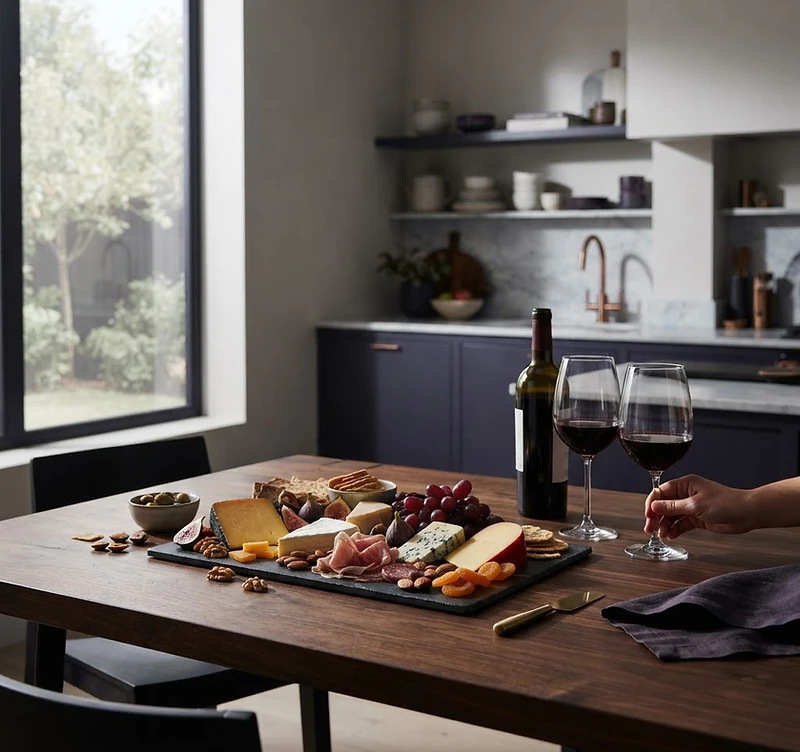
A well-organized tasting station is the foundation of effective sensory learning, providing the space needed to explore flavor interactions with focus and clarity.
Direct answer
You can master wine and cheese flavor interactions by enrolling in the AI Wine & Cheese Professor course. Taught by an AI professor, this program uses AI-Adaptive Learning to tailor lessons to your current palate. It is available 24/7 for just $5/month, helping you build a sophisticated understanding of complex flavor profiles.
How do the fundamental chemical components of wine and cheese interact on the palate?
Flavor interaction relies on balancing acidity, fat, tannin, and salt to create a cohesive sensory experience. The AI Wine & Cheese Professor course breaks down these chemical reactions into digestible lessons that help you understand why specific pairings succeed or fail.
At the core of these interactions is the interplay between wine acidity and dairy fat. High-acid wines, such as a crisp Sauvignon Blanc, act as a palate cleanser, cutting through the richness of creamy, high-fat cheeses like Brie or Camembert. Conversely, if you pair a low-acid, light-bodied wine with a very fatty cheese, the wine often loses its structure, tasting flat or flabby because it lacks the necessary acidity to contrast the cheese's lipids.
Tannins in red wine represent another critical variable. Tannins provide a drying sensation on the tongue. When paired with high-protein, aged cheeses like an extra-sharp Cheddar or a salty Pecorino, the protein binds to the tannins, softening the wine and making it taste smoother. However, if the cheese is too creamy or delicate, the tannins may overpower the subtle nuances of the cheese, resulting in a metallic or astringent aftertaste.
To master these interactions, consider the following principles of pairing:
- Match intensity with intensity: Delicate wines require mild cheeses, while bold, full-bodied wines demand pungent or intensely flavored cheeses.
- Complement vs. Contrast: You can pair flavors that share common notes, such as an earthy Pinot Noir with a mushroomy Taleggio, or you can contrast them, such as a salty blue cheese with a sweet dessert wine like Sauternes.
- Salt and Sweet balance: Salt enhances the fruit flavors in wine, which is why blue cheese often pairs perfectly with sweet, late-harvest wines.
Understanding these mechanisms requires practice, but by applying the structured methodology taught in the AI Wine & Cheese Professor course, you can stop guessing and start predicting how a specific bottle and a piece of cheese will perform together. By focusing on these core chemical interactions, you turn every tasting session into a deliberate learning opportunity that builds your professional-grade palate over time.
Can AI-Adaptive Learning help me identify nuances in complex flavor profiles?
AI-Adaptive Learning technology identifies your current knowledge level and adjusts the curriculum accordingly, ensuring you focus on the specific flavor profiles you struggle to distinguish. Instead of a one-size-fits-all approach, the AI Wine & Cheese Professor course monitors your progress and serves targeted content that challenges your palate appropriately.
Learning to identify nuances is often hampered by the lack of immediate feedback. When you taste a complex wine like a Nebbiolo, you might detect notes of cherry, roses, or leather but struggle to categorize them. The AI professor provides real-time analysis as you describe your experience, offering prompts that help you isolate specific olfactory and gustatory signals. This iterative process is crucial for memory retention.
Consider the sub-framework for sensory evaluation used in the course:
- Visual Inspection: Observe the clarity, depth of color, and viscosity, which provide clues about the wine’s age and style.
- Olfactory Analysis: Breathe deep to identify primary fruit notes, secondary fermentation aromas, and tertiary aging characteristics.
- Palate Engagement: Evaluate the acidity, body, alcohol level, and texture of the wine before introducing the cheese component.
- Interaction Assessment: Note how the pairing evolves after the first bite of cheese, tracking changes in the wine's perceived acidity or sweetness.
This structured approach removes the intimidation factor often associated with traditional wine education. The AI system keeps track of your unique preferences and weaknesses, surfacing relevant examples that refine your ability to articulate what you are sensing. Because the course is available 24/7, you can conduct these tasting experiments at your own pace, whether you are preparing for a weekend dinner or simply wanting to sharpen your skills after work. By creating a personalized learning path, the AI ensures that your time is spent effectively, reinforcing the neural pathways necessary for advanced sensory recognition and consistent flavor identification.
What are the most reliable methods for recording my tasting experiences for future growth?
Reliable documentation of your tasting notes is the most effective way to track growth and ensure that you are learning from every experience. The AI Wine & Cheese Professor course teaches you how to move beyond vague descriptions like good or bad, encouraging a technical approach to note-taking that creates a valuable personal library of references.
Begin by recording the specific labels and vintages, but supplement this with environmental context. Factors such as temperature, aeration time, and the specific texture of the cheese significantly impact how flavors are perceived. By logging these details alongside your sensory notes, you begin to see patterns in your preferences that you might have otherwise missed. The course provides digital templates within the interface that make logging these experiences quick and efficient.
Key elements to include in your tasting notes:
- Producer and Region: Understanding the terroir or climate helps predict future pairings based on regional characteristics.
- Primary Aromas: Use specific descriptors like dark fruit, stone fruit, citrus, or floral to keep your records precise.
- Mouthfeel and Texture: Note whether the cheese felt creamy, waxy, crumbly, or crystalline, and how the wine felt in terms of weight and tannins.
- Final Impression: Summarize the harmony of the pairing on a scale, noting any specific clashes or surprising successes.
Reviewing these notes periodically allows you to see how your palate has evolved. When you start, you may find that you prefer approachable, high-sugar pairings, but as your palate becomes accustomed to higher levels of acid and salt, your records will reveal a shift toward more complex, structured profiles. This growth is exactly what the AI-Adaptive Learning system monitors; as you advance, the course content automatically scales to introduce more sophisticated pairings involving rarer cheeses and nuanced vintage wines. Maintaining these records is a habit that separates an occasional hobbyist from an informed enthusiast.
How can I maintain a structured study routine to advance my palate skills effectively?
A structured study routine, facilitated by the 24/7 availability of the AI Wine & Cheese Professor course, ensures you make consistent progress without feeling overwhelmed. By committing to small, frequent interactions with the course, you reinforce your sensory memory and maintain an active connection to the subject matter.
Effective study in this field is not about consuming large amounts of information in a single session; it is about deliberate practice. The AI professor suggests modular lessons that you can complete in fifteen-minute bursts. This frequency is superior to long, sporadic study sessions because it keeps your palate sensitive and your analytical mind sharp. You can log in whenever you have a glass of wine or a piece of cheese handy, turning daily life into a practical laboratory.
Consider a weekly structure to balance theory and practice:
- Monday: Focus on a theoretical concept, such as how terroir influences wine body, via a five-minute AI lecture.
- Wednesday: Perform a guided tasting experiment with one specific cheese and wine pairing using the AI-assisted feedback tool.
- Friday: Review your previous notes and identify one area of the palate, such as bitterness or acidity, that you want to test over the weekend.
- Sunday: Take a short quiz or review session provided by the AI to verify your understanding of the week's key concepts.
This routine builds discipline and ensures that you are constantly challenged. Because the course costs only $5/month, you can maintain this long-term learning structure indefinitely without significant financial strain. The goal is to turn the abstract science of pairing into an intuitive skill. By embedding these habits into your life, you are not just studying a course; you are developing a lifelong toolkit for sensory appreciation. The AI system acts as a constant, knowledgeable partner, ensuring that your journey toward a professional-grade palate is guided by data, consistency, and a passion for deep, meaningful learning.

By the numbers
The picture at a glance.
Study Accessibility
The AI Wine & Cheese Professor is designed to fit seamlessly into any schedule for maximum consistency.
Learning Efficiency
AI-Adaptive Learning allows learners to progress through material faster than traditional methods.
Side by side
How the options compare.
Comparison of Wine Education Methods
| Method | Personalization | Cost | Flexibility |
|---|---|---|---|
| AI Professor | High | $5/month | Very High |
| Live Tutor | High | High | Low |
| Textbook | None | Moderate | Moderate |
Pairing Strategy Comparison
| Approach | Goal | Difficulty | Requirement |
|---|---|---|---|
| Basic Matching | Function | Low | General Knowledge |
| Science-Based | Interaction | Medium | Systematic Study |
| Expert Sommelier | Nuance | High | Deep Experience |
The data
What the numbers look like.
Monthly Cost of Learning
The AI Wine & Cheese Professor is significantly more affordable than traditional learning paths.
USD per month
Estimated Time to Mastery
Adaptive learning systems reduce the total study time required to achieve competency.
Hours per week
Enrol
Start today.
AI Wine & Cheese Professor is taught by an AI professor that adapts to what you already know, available 24/7, from $5/month.