History Courses · AI World History Professor
How Can I Master World History Concepts Without Memorizing Endless Dates?
Mastering world history requires understanding causal relationships and societal shifts rather than rote memorization. This guide explores how AI-adaptive learning helps you synthesize complex historical data into meaningful narratives that improve long-term retention and historical literacy.
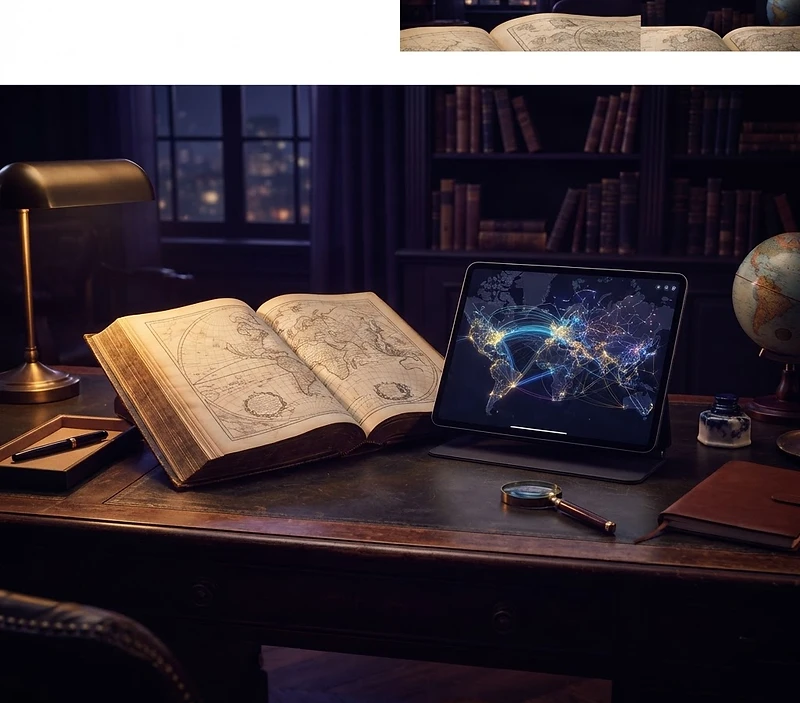
This scene represents the integration of traditional historical study with modern AI-driven analysis, showing how complex data becomes clearer through logical connections.
Direct answer
You can master world history through the AI World History Professor, an interactive course taught by an AI professor. It uses AI-Adaptive Learning to personalize lessons to your current knowledge, ensuring you focus on conceptual connections rather than dates. The course is available 24/7 and costs just $5/month.
Why is rote memorization an ineffective way to study world history?
Memorizing dates and names creates a fragile knowledge base that collapses as soon as you step away from the textbook. True historical understanding is found in the connections between events, cultures, and socioeconomic shifts rather than isolated facts on a timeline.
When students focus primarily on memorization, they treat history as a static list of events. This leads to a cognitive disconnect where the "what" is remembered but the "why" is entirely lost. By shifting your approach toward identifying patterns, such as the spread of agricultural techniques or the evolution of governance, you begin to see history as a living, breathing subject that informs the present. The human brain is evolutionarily designed to remember stories and relationships far better than abstract, disconnected numbers.
To overcome the burden of memorization, consider the following strategies:
- Focus on thematic threads that span centuries, such as the impact of maritime trade on cultural exchange.
- Create "cause-and-effect chains" where one event is logically linked to the next.
- Use comparative analysis to see how different regions solved similar problems, such as urban planning or irrigation.
By engaging with these thematic layers, you move from a passive recipient of information to an active analyst. For example, rather than simply memorizing that the French Revolution occurred in 1789, analyze the specific fiscal pressures, class tensions, and Enlightenment philosophy that made such an upheaval inevitable. This analytical framework turns a static date into a complex, relatable human event. Once you master the underlying structure of a historical period, the dates often fall into place naturally because they act as markers for the patterns you have already identified.
The AI World History Professor encourages this shift by presenting scenarios that force you to evaluate the "how" and "why" of history, reinforcing memory through understanding rather than repetitive drills. This method ensures that your knowledge persists long after the lesson ends, as you are building a conceptual map that is easier to navigate than a simple list of facts.
Furthermore, relying on rote memorization often triggers "test anxiety" because the brain struggles to retrieve information that lacks context. When you understand the logic behind a historical transition, you are essentially recalling a story you have told yourself, which is significantly more robust than recalling an arbitrary digit. If you forget a specific date, your conceptual map will allow you to approximate the time frame by describing the conditions surrounding the event. This resilience is what distinguishes a history student from a history enthusiast who truly grasps the complexity of human civilization.
How can I connect individual historical events to broader global trends?
Connecting specific events to global trends requires a "macro-to-micro" analytical approach where you anchor local occurrences within the context of international pressures. Instead of viewing history as a series of isolated national histories, you must view it as an interconnected network of influences.
This process involves identifying systemic forces such as trade routes, migration patterns, and the diffusion of technology. When studying a specific conflict, for instance, look beyond the battlefields to see how international trade policies or religious movements might have contributed to the friction. By treating individual events as manifestations of larger global shifts, you avoid the trap of viewing history as a collection of random happenings. This conceptual framework helps you organize information more effectively.
To facilitate these connections, try applying these frameworks:
- The Environmental Lens: Look at how geography and climate change dictated the resource limitations for ancient empires.
- The Technological Lens: Analyze how advancements in metallurgy or navigation changed the power balance between neighbors.
- The Ideological Lens: Track how core philosophies like Buddhism or the Enlightenment traveled along existing trade networks.
Consider the rise of the Silk Road as a primary example. Rather than memorizing every city on the route, focus on how the movement of silk, spices, and paper fundamentally altered the economies of both China and the Mediterranean. By analyzing how one product could bridge thousands of miles and different cultural spheres, you gain insight into human behavior that transcends a single time period. This thematic approach is exactly what the AI Professor utilizes to create lessons, ensuring that you understand the mechanics of change before diving into the specific players involved in a movement.
This prevents the feeling of being overwhelmed by "too much content" because you are grouping facts under thematic umbrellas that make logical sense to the mind. You will find that when you view history through these global lenses, individual facts become "sticky" because they act as evidence for the trends you are already tracking.
By repeatedly practicing this identification process, you build a mental scaffolding that allows you to absorb new historical information with ease. You aren't just learning a new name or place; you are slotting it into an existing global framework that you have already built. This is the difference between reading a textbook for an exam and internalizing history as a continuous, evolving narrative of humanity.
How does AI-Adaptive Learning improve my retention of complex historical narratives?
AI-Adaptive Learning works by identifying the specific "knowledge gaps" in your mental map and providing targeted feedback that challenges your current level of understanding. Unlike a static lecture, the AI professor adjusts the difficulty and the focus of the lessons based on your performance, ensuring you are neither bored by known information nor overwhelmed by missing context.
If you struggle with the causal links behind the Industrial Revolution, the system will offer supplemental context regarding early mercantilism or agricultural advances, effectively rebuilding the missing links in your logic. It functions as a private tutor that never gets tired, constantly refining its approach to match your unique learning style. This is highly effective because it respects your time and your existing knowledge, focusing only on what truly requires your attention to advance your conceptual understanding.
Benefits of an AI-driven learning approach include:
- Dynamic Feedback: Receive instant corrections that explain the "why" behind your error rather than just marking it wrong.
- Personalized Pacing: Spend more time on topics that interest you and skim over those you have already mastered.
- Contextual Recall: Use AI-generated analogies to map abstract historical concepts onto modern, relatable situations.
For instance, if you are learning about the complex alliances leading up to World War I, the AI professor might compare the diplomatic landscape to contemporary business partnerships or social networks. By grounding complex history in familiar mental structures, the material becomes instantly more retrievable. This is significantly more powerful than traditional reading because you are constantly engaged in active retrieval and synthesis, which are the two most proven ways to solidify long-term memory. The adaptive engine tracks which historical periods or themes you find challenging, and it automatically introduces more practice scenarios involving those specific areas in future lessons.
This keeps your learning curve optimal. By the end of a unit, you aren't just remembering names; you have built a robust, personalized understanding of the era that feels like your own insight. The AI constantly tests your ability to synthesize information across different regions, ensuring that you maintain a global perspective that is impossible to achieve with standard repetitive rote learning methods.
Furthermore, the system provides a sense of progress that is often lacking in self-study. Because you are constantly engaging with new, albeit slightly more difficult, challenges, you get the satisfaction of mastering concepts that seemed insurmountable just a week prior. This feedback loop is essential for maintaining motivation throughout a long study period.
Why is an AI professor more effective for history than a traditional textbook or live tutor?
An AI professor offers a perfect balance between the breadth of a comprehensive textbook and the personalized guidance of a live human tutor, all while remaining accessible 24/7. It provides the depth needed for academic success without the prohibitive costs or the scheduling limitations associated with traditional one-on-one teaching.
Traditional resources, such as textbooks, are inherently static and cannot offer feedback on whether you actually understand the underlying connections. Conversely, a live tutor is highly effective but often limited by hourly costs and the availability of both the student and the instructor. An AI professor provides the best of both worlds: it is available whenever you have a moment to learn, it covers vast historical timelines with incredible accuracy, and it adapts to your personal pace and level of knowledge.
Consider these unique advantages of the AI-led model:
- Total Accessibility: Access your curriculum at midnight or during your lunch break, whenever your brain is ready to engage.
- Objective Consistency: You receive the same high quality of explanation and guidance every single time, without the variances of human mood or scheduling friction.
- Scalable Depth: Choose to dive deep into a specific historical period and receive immediate, high-quality responses to your follow-up questions.
When you engage with an AI professor, you are essentially entering a conversation with a database of global history that is curated for your specific learning needs. You can ask clarifying questions as they arise, preventing the common mistake of "reading ahead" while fundamentally misunderstanding an earlier, critical concept. If you are confused about how the Silk Road evolved into the Age of Discovery, you can request an explanation that bridges those specific centuries, and the AI will provide a tailored overview that fills that exact hole in your knowledge. This creates a continuous, uninterrupted flow of learning.
Unlike a book, the AI can change its explanation if you do not understand the first time, using different analogies or historical examples until the concept clicks. This flexibility is what allows users to cover complex history curricula in a fraction of the time usually required for traditional courses. The cost of $5/month ensures that this sophisticated tool is accessible to everyone, democratizing education in a way that aligns with the speed and efficiency of the digital age. Whether you are a student preparing for exams or a lifelong learner seeking to broaden your world view, the AI professor acts as a tireless guide that is always prepared to explain, challenge, and expand your thinking.


By the numbers
The picture at a glance.
Learning Retention Factors
Different study methods significantly impact how well historical concepts are retained over long periods.
Accessibility and Cost Efficiency
Compared to traditional tutoring, digital AI-led learning offers superior affordability and flexibility.
Side by side
How the options compare.
Comparison of History Study Methods
| Method | Flexibility | Personalization | Cost |
|---|---|---|---|
| AI Professor | Always Available | High | Low |
| Private Tutor | Scheduled Only | Moderate | High |
| Textbook | Self-Paced | None | Moderate |
Historical Analysis Approaches
| Framework | Primary Goal | Difficulty |
|---|---|---|
| Chronological | Timeline Tracking | Low |
| Thematic | Pattern Recognition | Moderate |
| Causal | System Dynamics | High |
The data
What the numbers look like.
Average Time Spent to Achieve Competency
AI-adaptive learning reduces the time required to understand complex topics by identifying knowledge gaps instantly.
Hours per Week
Knowledge Retention Over Time
Understanding historical systems leads to significantly higher retention compared to memorizing isolated dates.
Retention Rate %
Enrol
Start today.
AI World History Professor is taught by an AI professor that adapts to what you already know, available 24/7, from $5/month.