
AI Course Bundles · Keep Up With AI – Course Bundle + AI Professor
How Can I Efficiently Manage My Professional AI Skillset To Stay Relevant As Technology Evolves?
This page explains how to build a sustainable system for managing your AI skillset amidst rapid technological shifts. It introduces an AI-driven approach to continuous learning that fits into your existing professional schedule without creating burnout.
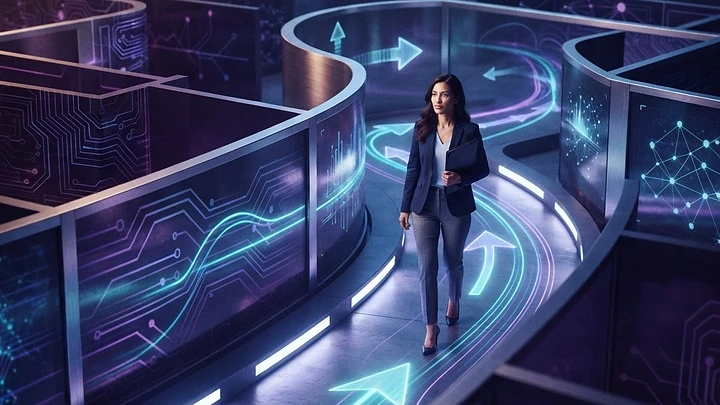
A personalized digital workspace illustrates how AI-adaptive learning integrates seamlessly into your daily professional life for maximum efficiency.
Direct answer
To stay relevant, you must move from passive consumption to active, adaptive mastery. The Keep Up With AI course bundle, taught by an AI professor, utilizes AI-Adaptive Learning to identify your existing skill gaps and focus only on high-impact tools, available 24/7 for a flat fee of $5/month.
How does an AI-adaptive system identify which AI skills are actually worth your time?
An AI-adaptive system functions by mapping your current professional competencies against a dynamic database of industry-relevant AI tools, prioritizing those that offer the highest return on your time investment. Unlike static curricula that treat every learner the same, this approach filters out the noise of transient trends, focusing your energy on fundamental capabilities like prompt engineering, workflow automation, and data literacy.
Most professionals struggle with the sheer volume of new releases because they lack a framework for valuation. When you start the course, the AI professor conducts a diagnostic assessment to determine your baseline knowledge. It then ignores what you already understand and builds a curriculum that plugs your specific knowledge gaps. This saves hours of redundant study.
Consider the difference between learning a general-purpose language model versus learning an agentic workflow tool. The AI-adaptive system recognizes that you do not need to memorize every feature of every model; instead, you need to understand the underlying logic of how these tools interface with your professional tasks. By focusing on these core principles, you gain the flexibility to pivot when new, better tools are released. You learn how to think about AI, rather than just how to click buttons.
This process is built on several foundational concepts:
- Competency mapping: Identifying your current skills against industry requirements.
- Incremental pruning: Removing obsolete tools from your personal stack to make room for new, high-performance replacements.
- Logical abstraction: Learning to recognize the shared patterns across different AI platforms.
- Modular application: Applying knowledge in small, manageable projects that directly correlate to your daily output.
By following this methodology, you move away from the trap of constant, frantic learning. You establish a stable foundation that allows you to evaluate new tools with a critical eye, asking whether they improve your efficiency or merely introduce unnecessary complexity. The goal is to reach a state where you are not just keeping up, but proactively shaping your own learning path based on your specific professional requirements. This structured approach ensures that your technical repertoire remains lean, effective, and highly adaptable to future shifts in the AI landscape.
Why is continuous professional development in AI considered a long-term investment?
Continuous development in AI is a long-term investment because the technology functions as a force multiplier for your existing expertise rather than a replacement for it. By committing to an ongoing, low-cost learning loop, you ensure that your value as a professional grows in tandem with the capabilities of the tools you manage.
Many learners approach AI as a one-time project, but this is a mistake because the state-of-the-art changes every few weeks. When you treat your education as a subscription-based, modular process, you treat it like a utility that provides compounding benefits. The $5/month model makes this sustainable, allowing you to treat AI knowledge as a standard operating cost of your career.
Consider a graphic designer or a data analyst. If these professionals only learn the version of AI available today, they will find themselves obsolete when the next generation of generative models emerges next year. However, if they learn the conceptual framework of AI-human collaboration—how to iterate, how to curate outputs, and how to verify information—they become immune to tool-level obsolescence. The skill is no longer the tool itself, but the ability to translate professional intent into AI-driven results.
To manage this investment effectively, you should prioritize:
- Cross-domain exposure: Borrowing problem-solving techniques from fields adjacent to your own.
- Iterative feedback loops: Using AI to grade your own prompts and outputs to see where improvements can be made.
- Strategic resource allocation: Spending your limited learning time on technologies with high adoption rates.
- Professional networking: Sharing insights with peers to see how others are successfully integrating these tools.
This investment strategy changes your psychological relationship with the technology. Instead of fearing that your skills will become outdated, you begin to view change as an opportunity to upgrade your capabilities. This shift from defensive learning to offensive growth is what separates top-tier professionals from the rest. The key is to remain consistent in your efforts, dedicating small blocks of time regularly rather than attempting to "cram" AI knowledge during infrequent, high-stress periods. This consistency is the only way to build true proficiency over time.
How can you integrate AI-driven learning into a busy professional schedule?
Integrating AI-driven learning into a busy schedule requires a shift from fixed-time classroom models to on-demand, bite-sized learning modules that exist within your workflow. Since this course is available 24/7, you can access exactly the content you need during short breaks or as you encounter specific challenges in your actual daily work.
When you face a complex task at work, you should not have to leave your environment to watch an hour-long lecture. Instead, you should be able to access targeted, AI-assisted guidance that addresses your current hurdle immediately. This "just-in-time" learning is far more effective than "just-in-case" learning because the knowledge is anchored to a real, pressing problem you are solving in the moment.
Let us look at a practical example: automating a reporting task. Instead of searching through generic tutorials for hours, you input the specific nature of your report into the AI professor. It identifies which specific automation modules in the course will solve your issue, guides you through a five-minute setup process, and provides a template for future iterations. You solve the problem, learn the underlying principle, and move on with your day.
Practical steps for effective integration include:
- Micro-learning: Breaking down complex topics into 10-minute sessions that fit between meetings.
- Task-anchoring: Linking every learning session to a specific project you are currently working on.
- Workflow automation: Using the skills you learn to build tools that save you time on future learning.
- Active recall: Challenging yourself to explain what you learned to a colleague to cement your understanding.
By integrating these methods, you eliminate the friction between learning and doing. The barrier to entry for acquiring new skills drops significantly when the learning process feels like a shortcut rather than a chore. This is how you stay competitive without sacrificing your work-life balance or burning out from information overload. You essentially treat your professional development as a continuous, background optimization process that runs alongside your standard responsibilities, ultimately enhancing your capacity to deliver high-quality results consistently.
Can AI-adaptive learning replace traditional training methods effectively?
AI-adaptive learning effectively replaces traditional training because it offers personalization at scale, which is impossible in a classroom setting where one teacher must accommodate dozens of different needs. While traditional methods rely on a standardized curriculum, AI-adaptive systems create a unique path for every learner, ensuring that everyone reaches proficiency at their own speed based on their specific starting point.
In a typical corporate training or university course, the pace is set by the median student, which leaves advanced learners bored and struggling learners behind. An AI professor removes this tension by dynamically adjusting the difficulty of the material as you progress. If you demonstrate mastery of a topic early, the system skips the redundant exercises and moves you to more advanced concepts. If you struggle, it provides extra support and alternative explanations until the concept is clear.
Furthermore, traditional training is often static, meaning that even if the technology changes, the syllabus remains the same for years. In contrast, an AI-led platform is updated in near real-time. As new libraries, interfaces, or methodologies emerge, the content is adjusted to include them. This ensures you are always training on the most current industry standards rather than concepts that were relevant five years ago.
Consider these advantages of the AI-adaptive approach:
- Optimized feedback loops: You receive immediate corrections on your work rather than waiting for an instructor to review it.
- Cost-efficiency: You pay for access to the content rather than for the time of a human lecturer.
- Accessibility: You can learn in your pajamas, at midnight, or on your commute without geographic restrictions.
- Scalable mastery: You can repeat modules as many times as needed without the social pressure of a group environment.
By leveraging these benefits, you achieve a level of depth that is difficult to replicate with traditional seminars or textbooks. You move from a passive recipient of information to an active participant in your own education. This ensures that you not only learn the tools but also understand the strategy and the intuition behind them. You are building a durable, long-term competency that evolves alongside the technology, keeping you at the forefront of your industry regardless of how fast the landscape changes.

By the numbers
The picture at a glance.
Efficiency Gains with AI-Adaptive Learning
Comparing the speed of skill acquisition between traditional methods and AI-driven adaptive learning.
Learning Accessibility Metrics
The availability and flexibility provided by an AI professor compared to standard educational models.
Side by side
How the options compare.
Learning Method Comparison
| Method | Cost | Pace | Relevance |
|---|---|---|---|
| AI Professor | $5/mo | Self-paced | Real-time |
| Live Tutor | $50+/hr | Fixed | Variable |
| Textbooks | $20/ea | Slow | Outdated |
Professional Skill Development Strategies
| Strategy | Effort Level | Sustainability | Output Quality |
|---|---|---|---|
| Cramming | High | Low | Low |
| Adaptive Learning | Low | High | High |
| Passive Reading | Medium | Low | Medium |
The data
What the numbers look like.
Monthly Cost of Learning
The stark difference in monthly expenditure between human-led tutoring and AI-led adaptive systems.
USD per month
Average Time Required to Master AI Workflows
Hours per week dedicated to achieving proficiency using different educational frameworks.
Hours per week
Enrol
Start today.
Keep Up With AI – Course Bundle + AI Professor is taught by an AI professor that adapts to what you already know, available 24/7, from $5/month.