
Personal Interest Courses · AI Personal Security & Emergency Preparedness Professor
How Can I Effectively Evaluate My Personal Security Vulnerabilities and Prepare for Emergencies?
This guide helps you assess potential risks in your daily environment while building a scalable preparedness plan. It introduces an AI-driven approach to safety that adapts to your specific lifestyle, geographic location, and resource availability for optimal personal security.
A personalized digital dashboard helps you visualize your home security and emergency response strategies within your specific local environment.
Direct answer
To systematically evaluate your vulnerabilities, use our AI Personal Security & Emergency Preparedness Professor. Taught by an AI professor, this course utilizes AI-Adaptive Learning to tailor safety protocols to your specific circumstances. It provides 24/7 access to expert guidance for just $5/month, ensuring you build a robust and actionable emergency plan.
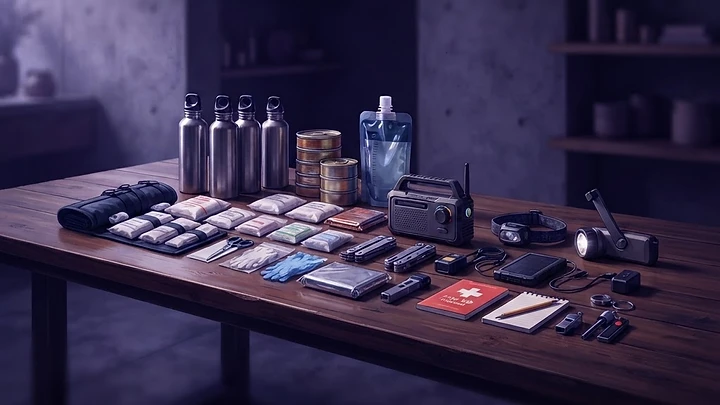
What specific environmental factors contribute to your personal security risk profile? Understanding your personal security begins with recognizing that risk is rarely uniform; it is highly dependent on your specific environmental context and daily habits. Identifying these factors requires an honest audit of your physical surroundings, your digital footprint, and the infrastructure of the community where you live. Environmental security risk is composed of three primary pillars: proximity, predictability, and vulnerability. Proximity refers to your physical location relative to high-risk zones, such as areas prone to natural disasters like wildfires or floods, or urban sectors with high crime rates. Predictability involves the patterns of your daily life—your commute, your grocery shopping times, and your routine interactions—which can be exploited if they become overly rigid. Vulnerability represents the weakest link in your defense, such as a lack of hardened entry points at home or insufficient backup power for essential medical devices. To begin your assessment, consider these key areas: * Your home structural integrity and physical security systems. * Your proximity to emergency services and medical facilities. * The frequency and severity of historical weather events in your region. * The reliability of your local power and water supply infrastructure. When you approach your audit, start by mapping out your routine. A simple way to do this is to list every location you spend more than two hours in per day. For each location, identify the nearest exits, the most likely form of a disruptive event, and the resources you have currently on hand to handle a 72-hour period of isolation. Do not fall into the trap of assuming that standardized checklists will suffice. A resident in a high-rise apartment in a dense city faces different emergency realities than a homeowner in a remote, rural area. Your assessment must account for the specific demographic and geographic realities of your life to be truly effective. Once you have identified these factors, you can begin to categorize them by severity. Prioritize threats that are both highly probable and highly impactful. For instance, if you live in an earthquake-prone zone, the structural reinforcement of your shelving is a high-priority, high-impact action. By breaking down your environment into these manageable, data-driven segments, you shift your mindset from reactive anxiety to proactive, structural preparation. This foundational step is the cornerstone of the personal security curriculum, ensuring that every subsequent preparation effort is targeted toward actual risks rather than hypothetical fears. The AI-Adaptive Learning system evaluates your specific inputs to prioritize these risks, helping you focus on the actions that provide the most significant safety dividends immediately, rather than wasting time on low-impact preparations. Ultimately, your goal is to construct a baseline of 'normalcy' for your specific environment. By knowing what is normal for your area, you become much more effective at detecting anomalies. Whether it is an unexpected infrastructure failure or a social disruption, you will be better equipped to distinguish between minor inconveniences and genuine threats that require immediate activation of your safety protocols. This requires a shift in how you process information, moving from passive observation to active security awareness, which our coursework emphasizes through guided situational awareness exercises that evolve as your environment shifts over time. ## How can you build a 72-hour emergency kit that is actually relevant to your specific needs? A functional 72-hour emergency kit is not merely a collection of generic supplies purchased in a pre-made box; it is a specialized toolkit designed to sustain your specific bodily functions and situational requirements during an infrastructure collapse. Effective preparation requires selecting items based on the 'Rule of Threes' for survival: three minutes without air, three hours without shelter, three days without water, and three weeks without food. Building this kit begins with identifying your unique caloric needs, medication requirements, and local climate realities, rather than buying off-the-shelf survival gear that may remain unused and ineffective. To build a robust kit, focus on these essential categories: * Water purification and storage capacity for at least one gallon per person per day. * Non-perishable, energy-dense foods that require zero preparation or heat. * Redundant lighting, communication, and power sources that do not rely on the local grid. * Personal hygiene and medical supplies tailored to your current prescriptions or health conditions. Start the assembly process by analyzing the primary environmental hazards you identified in the previous step. If your threat analysis highlights cold-weather disruptions, your kit must prioritize high-quality insulation and non-electric heating options. If your risk profile highlights water contamination during floods, you must prioritize advanced mechanical filtration and chemical purification tablets. You should also maintain a document pouch containing physical copies of critical records—identity, medical history, property deeds, and local maps—because digital information may be inaccessible during a network blackout. The organizational structure of your kit is just as important as the contents. Use modular containers that can be rapidly relocated to a vehicle or carried by hand if you need to evacuate. Practice opening and using every single item in your kit before an emergency occurs. If you have not used a portable stove or a manual water filter in a stress-free environment, you will struggle to use it when your nerves are frayed. This practical rehearsal is a core component of the personal security course, where you will simulate 'load-out' drills that test the ergonomics and accessibility of your gear under different scenarios. Remember that every item in your kit has a weight and volume cost. Do not over-pack items that offer low utility. The goal is portability and sustainability. By refining your kit through iterative testing, you create a system that serves as a force multiplier for your resilience, ensuring that when the environment becomes hostile, you are not struggling with your own equipment. Through our AI-guided simulations, you will receive feedback on how your specific kit configuration would hold up against different types of disaster scenarios, allowing you to optimize your weight-to-utility ratio before it truly matters. ## What are the most effective digital security practices for keeping your personal communications and financial assets safe during a crisis? Digital security during an emergency is often overlooked, yet it is the primary bridge between your immediate survival and your long-term recovery. When the physical world becomes chaotic, your digital presence remains the primary method for coordinating with family, securing finances, and accessing information that can determine your safety. Maintaining digital integrity requires hardening your accounts against unauthorized access while simultaneously ensuring that you can access essential data even when traditional networks are offline or unstable. Consider these foundational digital security practices: * Implementing multi-factor authentication on every financial and communication account. * Creating encrypted, offline backups of essential data on hardened hardware. * Utilizing secure, private messaging platforms for sensitive family coordination. * Maintaining a secondary communication method that bypasses standard cellular reliance. The most common vulnerability is a lack of credential management. In a crisis, if you are locked out of your banking or email, your ability to respond to shifting circumstances is crippled. You should use a password manager to secure your credentials, ensuring that you can access your accounts without needing to memorize complex codes during a period of high stress. Furthermore, consider the physical security of your devices. During an emergency, a lost or stolen phone can provide an intruder with access to your entire life. Use biometric locks, remote wipe capabilities, and full-disk encryption to ensure that your digital footprint does not become a secondary liability. Another critical aspect of digital survival is information vetting. In the age of social media, misinformation spreads at the speed of light during disasters. You must have a pre-defined list of verified, trusted sources of information, including local government, official utility providers, and credible weather services. Learn to recognize the patterns of panic-driven content and avoid sharing unverified reports, which can clog communication channels and create confusion. Our course teaches you to establish a 'digital survival hierarchy' that ranks which data must be saved, which data can be sacrificed, and which accounts need immediate lockdown during an emergency. This involves setting up 'dead-man' protocols and delegation plans for your digital assets, ensuring that your family or designated emergency contacts can manage your affairs if you are incapacitated. By treating your digital security as a physical security asset, you create a robust perimeter that protects your privacy and your access to resources when it counts the most. ## How do you design a comprehensive emergency evacuation plan that accounts for multiple scenarios? A professional-grade evacuation plan must be flexible enough to account for multiple disruption scenarios, ranging from a localized gas leak to a large-scale evacuation order. A static plan that assumes everything goes according to the primary route is a failure waiting to happen. True preparation involves mapping out primary, secondary, and tertiary evacuation routes, and identifying 'go-points' where you can rendezvous with family members if you become separated. Your evacuation strategy should be based on a clear 'trigger' system—specific conditions under which you will leave your home—so that you do not delay your departure until the situation becomes untenable. To create a flexible, actionable evacuation plan, focus on these tactical elements: * Defining clear, binary 'go' triggers based on objective criteria like fire proximity or utility failure. * Mapping multi-modal routes—using roads, transit lines, or non-vehicle paths if necessary. * Establishing rendezvous points that are far enough away to be safe but close enough to be accessible. * Communicating the plan clearly to all family members so that every individual knows their specific responsibilities. The secret to a successful evacuation is the reduction of 'decision fatigue.' When an emergency hits, you do not want to be debating which documents to pack or which route to take. You want to be executing a plan that you have already internalized. Create a physical 'go-bag' for every person in your household, and store it near your primary exit. This bag should be pre-stocked with the absolute necessities, including cash, copies of identification, spare keys, and a basic first-aid kit. Additionally, designate a contact person outside your immediate area—someone who lives in a different state or region—to serve as the clearinghouse for information. During disasters, local cellular towers are often overwhelmed, but long-distance messaging to a remote contact may still function. By funneling all status updates through one person, you ensure that everyone stays informed without creating a massive coordination burden on yourself. Our course provides a simulated environment where you can 'stress test' your plan against variables like traffic congestion, infrastructure failure, and unpredictable weather, allowing you to stress-test your strategy before you ever need to use it in the real world. By practicing these elements regularly, you transform your emergency preparedness from a theoretical exercise into an intuitive response, significantly increasing your chances of maintaining stability and safety regardless of the crisis.

By the numbers
The picture at a glance.
Core Preparedness Benefits
Why users engage with AI-driven personal security training to enhance their daily safety protocols.
Assessment Metrics
The primary areas of focus for developing a resilient and responsive personal security framework.
Side by side
How the options compare.
Methods of Security Education
| Method | Cost Structure | Customization Level | Support Access |
|---|---|---|---|
| AI Professor | $5/month | High | 24/7 |
| In-person Seminar | $100/session | Low | Scheduled |
| Textbook Study | $40 flat | None | None |
Preparedness Planning Approaches
| Strategy | Data Usage | Adaptability | Complexity |
|---|---|---|---|
| Adaptive AI | High | Dynamic | Managed |
| Static Checklist | Low | None | Simple |
| Expert Consultant | High | Manual | High |
The data
What the numbers look like.
Monthly Cost Comparison
A comparison of average monthly expenses for various personal security training methods.
USD per month
Learning Retention by Format
Expected retention levels based on how personal security information is delivered and practiced.
Percentage
Enrol
Start today.
AI Personal Security & Emergency Preparedness Professor is taught by an AI professor that adapts to what you already know, available 24/7, from $5/month.