

Personal Interest Courses · AI Personal Security & Emergency Preparedness Professor
How Can I Effectively Assess My Home for Personal Security and Emergency Preparedness?
This page explains how to systematically evaluate your home’s security vulnerabilities and build a robust emergency plan. It introduces our specialized AI-driven course designed to help you create a personalized safety strategy for your household's unique needs.
A well-assessed home balances visibility and security, which is the foundational step in protecting your household from unexpected threats.
Direct answer
To effectively assess your home, you must map physical vulnerabilities against potential environmental risks. Our AI Personal Security & Emergency Preparedness Professor provides a structured framework for this analysis. This AI-adaptive learning experience is available 24/7 to guide your progress, ensuring a customized plan for only $5/month.
What are the most common vulnerabilities when assessing home security?
Most residential security gaps originate from a failure to view the property through an adversarial lens, ignoring simple points of entry or environmental weaknesses. Identifying these requires a disciplined review of your perimeter, interior access points, and digital footprints that might signal your habits to outsiders.
Security experts often use a concentric circles approach to evaluate safety. The outermost circle is your neighborhood or street, the middle circle is your property perimeter, and the innermost circle is the physical structure of your home. When performing a self-assessment, you should look for patterns that would discourage a casual intruder or highlight an easy target for those seeking vulnerabilities. Consider these primary physical access points:
- Sliding glass doors that lack secondary locking mechanisms or security bars.
- Basement windows that are shielded from street view by dense landscaping.
- Unsecured service entrances or pet doors large enough for unauthorized access.
- Outdated door strikes that do not have long, heavy-duty screws reaching the wall studs.
Beyond physical entry, you must consider the information you inadvertently broadcast. Do you dispose of boxes for expensive electronics in a way that signals your latest purchases? Does your home automation system appear active or vacant based on consistent lighting patterns? Assessing these vulnerabilities means understanding that security is not just about a locked door, but about managing the impression your home gives off to passersby.
When we evaluate risks, we typically use a simple grid to categorize threats into likelihood and impact. For instance, a broken lock has a high likelihood of exploitation and a high impact, requiring immediate attention. A missing fire extinguisher in a garage has a lower daily likelihood but a catastrophic potential impact. By creating a physical walk-through checklist, you gain a baseline for your security status. This process of systematic documentation allows you to move from vague anxiety about safety to a concrete plan of action, prioritizing tasks that offer the highest level of risk reduction for your specific budget and time investment.
How does the AI professor help tailor emergency preparedness to my location?
Personalized preparedness requires integrating specific geographic hazards with your household's unique composition, which is exactly where AI-Adaptive Learning shines. By inputting your local climate data and logistical constraints, the AI professor helps you build a strategy that avoids generic advice in favor of actionable local relevance.
Standard disaster kits often suggest a generic list of supplies, but those lists rarely account for regional specifics like high-altitude snowstorms, coastal flood zones, or arid wildfire areas. An AI professor analyzes your specific risk profile to suggest targeted supplies rather than mass-market kits that might include unnecessary items. The system learns what you already know about your region and pushes you to consider neglected variables:
-
How to maintain power for medical devices during multi-day grid outages.
-
Creating communication plans that account for specific cell tower density in your area.
-
Staging evacuation routes that avoid common chokepoints during seasonal weather events.
-
Identifying local resources like water sources or emergency shelter locations near your workplace.
Using AI to adapt your learning means the professor monitors your responses to simulation scenarios, identifying where you are over-prepared in one area and under-prepared in another. If you have spent five hours researching water filtration but have zero knowledge of how to shut off your main gas line, the AI will naturally prioritize the latter during your next study session. This creates a balanced learning path that grows as your home infrastructure does.
Think of the AI as a coach who understands that preparedness is a process of iterative improvement. You do not build a perfect safety plan in a weekend. Instead, you address one vulnerability at a time, moving from low-cost behavioral changes to higher-cost infrastructure upgrades. By utilizing 24/7 access, you can ask the professor specific questions in the moment of learning, such as how to secure heavy appliances during an earthquake in a rental property versus an owned home, ensuring your plan remains compliant with your living situation.
Why is a household emergency plan more than just a supply list?
An effective emergency plan functions as a decision-making framework, not just a storage guide for cans and batteries. It provides a shared mental model for every member of your household, ensuring that during a high-stress event, everyone knows exactly what their role is and where the reunification points are located.
Many people fail at preparedness because they confuse hoarding supplies with building a strategy. A supply list is useless if the people intended to use it do not know how to operate the equipment or where to go when the supplies are inaccessible. To build a functional household plan, focus on these critical operational components:
- Pre-defined roles: Assign specific tasks like securing the home, checking neighbors, or monitoring official emergency broadcasts to individual family members.
- Communication contingencies: Create physical contact cards that include out-of-area relatives who can serve as central message hubs if local infrastructure fails.
- Documentation backup: Store essential documents like insurance policies, identification, and medical records in both encrypted digital formats and waterproof physical binders.
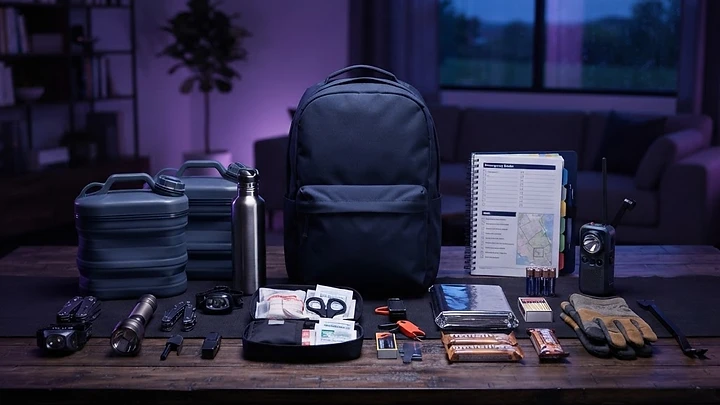
- Evacuation readiness: Maintain a 'go-bag' for every household member that is tailored to their specific dietary, medical, and hygiene needs, ensuring it is ready for immediate departure.
When we build these plans, we consider the difference between sheltering in place versus rapid evacuation. Sheltering in place relies on your ability to secure the interior, maintain temperature control, and manage waste. Evacuation relies on your ability to reach a safe destination while potentially navigating congested transit routes. An AI professor will guide you through these two divergent paths by presenting scenarios that test your decision-making under time pressure.
Ultimately, a good plan reduces the cognitive load during an emergency. When you are under stress, your brain’s ability to process new information drops significantly. By practicing your plan—running 'fire drills' at home—you build muscle memory. The goal is to reach a state where your response to a power outage or a severe storm is reflexive, reducing the likelihood of panic and improving your household’s actual safety outcomes.
How can I maintain my security and preparedness plans over time?
Maintaining a security plan requires a schedule of recurring maintenance and periodic testing, rather than a one-time setup. Over time, your household composition, your neighborhood, and your local infrastructure will change, meaning your security and emergency protocols must be reviewed and updated to stay effective.
Consistency is the greatest enemy of preparedness. It is easy to feel motivated to fix your security after an incident in the news, but that energy often fades. We suggest a 'cyclical audit' method to keep your plans current without requiring constant, heavy effort. Consider these phases for your maintenance cycle:
- Quarterly audits: Check the expiration dates on food, water, and medications, and test smoke detectors and security sensors.
- Seasonal reviews: Adjust your emergency supplies based on upcoming weather extremes, such as prepping for summer heat or winter freeze.
- Annual drills: Conduct a full household drill that includes practicing your communication plan and checking your evacuation route accessibility.
- Technology updates: Review the status of security hardware, such as firmware updates for cameras or replacing batteries in smart locks.
Using an AI-adaptive learning tool allows you to treat these tasks as modular projects. Instead of viewing a whole 'security overhaul' as a daunting task, the AI breaks it into small, manageable sessions that you can complete in minutes. This keeps the work from piling up and turning into an overwhelming chore. If you move to a new home, the AI can reset your context, helping you apply the same structural logic to a different physical layout while accounting for new environmental risks.
By keeping your knowledge sharp, you ensure that your security assets remain effective. An unused alarm system is just a wall ornament if you forget the codes or how to reset it. A generator that has not been tested in two years is a liability, not an asset. Maintenance is the bridge between having a plan and actually being safe. As you engage with the course, you will learn how to automate your own reminders, effectively creating a sustainable security lifestyle that requires minimal maintenance but provides maximum peace of mind.

By the numbers
The picture at a glance.
Efficiency of AI Learning
AI-adaptive learning creates faster results by focusing only on the gaps in your knowledge.
Core Preparedness Pillars
A balanced security plan covers these essential areas of focus for every household.
Side by side
How the options compare.
Methodologies of Learning Security
| Method | Cost | Adaptivity | Access |
|---|---|---|---|
| AI Professor | $5/mo | High | 24/7 |
| Private Tutor | $50+/hr | Moderate | Scheduled |
| Textbook Study | $20-$50 | Low | Static |
Security Planning Approaches
| Plan Type | Complexity | Updates | Focus |
|---|---|---|---|
| Generic List | Low | Rare | Supplies |
| AI-Customized | High | Frequent | Risk/Strategy |
| Basic DIY | Moderate | Annual | Hardware |
The data
What the numbers look like.
Monthly Cost Comparison
AI-taught courses provide professional-grade knowledge at a fraction of traditional tutoring costs.
USD per month
Knowledge Retention over Time
Interactive, adaptive learning improves long-term recall compared to passive reading.
Relative Retention
Enrol
Start today.
AI Personal Security & Emergency Preparedness Professor is taught by an AI professor that adapts to what you already know, available 24/7, from $5/month.